Post #68 – Women’s Memoirs, Author Conversations – Kendra Bonnett and Matilda Butler
Journaling Results in Source Material for Memoir
Phyllis Mattson is the author of War Orphan in San Francisco, a memoir describing her childhood lived in America while her mother was caught in Austria and her father in an internment camp in Australia. (Hopefully, that peeks your interest.)
Today’s post is quite a different story. Recently Phyllis sent me a draft of one chapter in her new memoir with a working title of: Teaching English in Jinan, 1989-90. She writes:
“I had been to China in l980 on a health study tour, and was so fascinated with what I saw that I started to do some research. I found a “China People’s Friendship Association” in the San Jose area, and monthly heard from people who had taught English in China. I thought, “I could do that.” After all, I had college degrees in anthropology and public health and could probably teach. I got a certificate in Teaching English, and thus became qualified. China presented me with my first experience of teaching English.
“It was a fascinating experience that I chronicled daily in my journal. Only now have I started to write about that year, relying on my journal as a rich resource.
“I’ve visited China several times since my year there, leading tours to China, but always visiting Jinan, the city where I taught. I continue to correspond with several of my students.”
Singing in China: A Memoir Vignette
By Phyllis H. Mattson
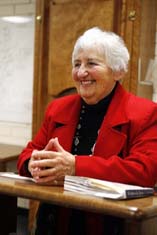
Photograph by Daniel Sato
Once in China, I found myself teaching four freshman classes. My students were assigned classes according to their grades, I think, but there may have been other underlying reasons for the selection, perhaps political, perhaps economic. In all classes there were some students who were extremely fluent in English and had good accents; they would have either had an excellent high school teacher or have had contact with foreigners.
I began systematic use of the textbook. I said a word from the sound group — ah or ae, for example — and the class responded in unison. The truth is that I was poorly prepared for this basic kind of English teaching, but it worked — sooner or later, most students got the sounds right. Of course, there were many English sounds that were difficult, but pronunciation was important so that occupied much of the time.
As something different to do in class instead of sound drills, I started to teach them songs. This was difficult for me — I can’t carry a tune. Then I hit upon the idea to teach them “Old MacDonald Had A Farm.” As it turned out, this was a good choice for two reasons. First, the song contained new vocabulary not typically found in textbooks. And the much more important second reason, the song didn’t require much of me in voice. The first challenge was the sounds the animals made. To my surprise, the sounds are not universal. I no longer remember the Chinese version of “quack, quack,” but it was quite different. Nor did they have “moo-moo” for the cow sound, (no cows in the country) or “oink” for the pig sound, but we had fun playing with them. I asked them to use the English sounds. It turned out to be a good exercise for short (moo, baa) and combined vowels (oink, meow).
Later, I was invited to a lunch party for faculty, and to my surprise, after eating our meal, each person was asked to perform. One person with a beautiful voice sang a long aria from a Beijing Opera. Others sang songs unfamiliar to me. All too soon it was my turn. My repertoire was short—all I could think of was Old MacDonald, just as I had taught my students. Fortunately, the faculty was responsive and joined my chorus of:
“With a moo-moo here,
And a moo-moo there
Here a moo, there a moo,
Everywhere a moo-ooo
Old MacDonald had a farm,
Ee i ee i oh!”
All the faculty praised me. Well, they were polite, no matter what.
Later, I found that singing for each other was done at parties. At a New Year’s party, students were the performers for the whole school, and to my surprise, almost everyone had prepared a song. Some had very good voices, some less so, but everyone was polite, and after the performances, we rolled up our sleeves and everyone participated in making dumplings. But that’s another story.
At the end of the year of teaching, I was asked to tape one of the books with my American voice. The project lasted several days, and had to be undertaken at a time when my voice was already compromised by the bad air in the city caused by coal burning. This was a job I did not enjoy.