Post #30 – Women’s Memoirs, ScrapMoir – Matilda Butler and Kendra Bonnett
By Bettyann Schmidt
“To be rooted is perhaps the most important but least understood need of the human soul.” Simone Weil
A Sense of Place Defined
The recent visit to my hometown for my aunt’s funeral filled me with an almost overwhelming sense of place.
My origins. Where your family lives, and its people, are a factor in feeling your sense of place. Stories are a part of your sense of place.
Here on Women’s Memoirs, Matilda Butler and Kendra Bonnett interviewed Susan Wittig Albert about her recent memoir, Alone Together: A Memoir of Marriage and Place, noting her “integration of sense of place in memoir.”
Michelle Rockwell, in her review of the memoir on this website, says:
“As a writer, I learned that place goes beyond setting. Albert shows how place grows from the roots of history and extends beyond the borders of home. There is place in union and in solitude, in self and spirit, in heart and intellect. And through it all, we are together and alone.”
Rockwell plucks a quote from the book that got me to thinking:
“Naming connects us to the places that have significance for us, places that tell our stories. How do we know where in the world we are if we can’t place ourselves in the landscape? How can we describe a natural setting if we don’t have a vocabulary that defines its features?” (p.48).
I grew up in a place called “Over the Rhine” in Cincinnati. The last place I lived with my parents was still in the Rhine neighborhood. My paternal grandmother, until going into an assisted living facility and eventually my aunt’s home, never left the Rhine community. It was inner city and poor. The area we lived in first and last was “Clifton Heights.” In between were other places, but Clifton is the name of my place. Over the Rhine is another name. I guess “inner city” is the phrase I use to describe my place the most, however, because it helps people conjure in their minds the feel and nature of the location.
When writing about place in my scrapbooks, I’m also influenced by Rick Bragg, whose books describe place and characters with such vivid precision that I almost believe I am there in those backwoods of dirt-poor Alabama. His readers know his family because he brings them to life on his pages, as he does the terrain they traveled.
In his book, Ava’s Man, he writes,
“… All this, all this sense of place, of family, of love, from the fact that a dead man, a man I never even met, lies in this ground.”
These are his feelings on returning to the place of his boyhood for a family reunion. He’d earned the success he worked for as a top journalist for the New York Times and even received a Pulitzer. He’d left the abject poverty of his youth. Yet, the sense of place, family, his roots, pulled him home again. More than that, the pride for his family shown through in his words.
And in All Over But the Shoutin’, he begins in the first chapter writing about the tornado on Palm Sunday 1994 that struck his hometown of Piedmont, Alabama:
“This is a place where grandmothers hold babies on their laps under the stars and whisper in their ears that the lights in the sky are holes in the floor of heaven. This is a place where the song Jesus Loves Me has rocked generations to sleep, and heaven is not a concept, but a destination.”
I can visualize these scenes, perhaps because the part of the south I’ve lived in the last 40 years is like Piedmont, Alabama, in this respect. My community revolves around the little white, unassuming church that dates back as far as the land, and each family’s generations go back so far that almost everyone is related in some way. In these places, it’s all about place and the people who live here and are buried here.
Wikipedia defines “Sense of Place” thus:
“Places said to have a strong ‘sense of place’ have a strong identity and character that is deeply felt by local inhabitants and by many visitors. Sense of place is a social phenomenon that exists independently of any one individual’s perceptions or experiences, yet is dependent on human engagement for its existence. Such a feeling may be derived from the natural environment, but is more often made up of a mix of natural and cultural features in the landscape, and generally includes the people who occupy the place.”
My Own Spot on the Map
“The ache for home lives in all of us, the safe place where we can go as we are and not be questioned.” Maya Angelou
Reading books that explore down-home place setting, my heart began looking homeward as I matured. After 20 years in the greater Nashville area, I got a divorce and set out on my own. My father never understood why I didn’t come home, but by this time I had a daughter married to a Tennessee boy and my first granddaughter. My children had grown up here. I felt my home was now in Tennessee.
On every trip home, however, I soaked up my ethnic heritage, took photos of my memorable places, and discussed with anyone who would engage me in conversation about our ancestors. I found out I was the only one who cared. The others hadn’t left, so maybe they were like I was all those years ago. Taking it for granted. On our last trip home for Oktoberfest last year, I snapped more photos than usual. I visited old neighborhoods, breathing in the scent of familiarity. I felt the drawing in of my surroundings. I saw my once dingy city on the river as a glorious metropolis with all the ethic food one could want.
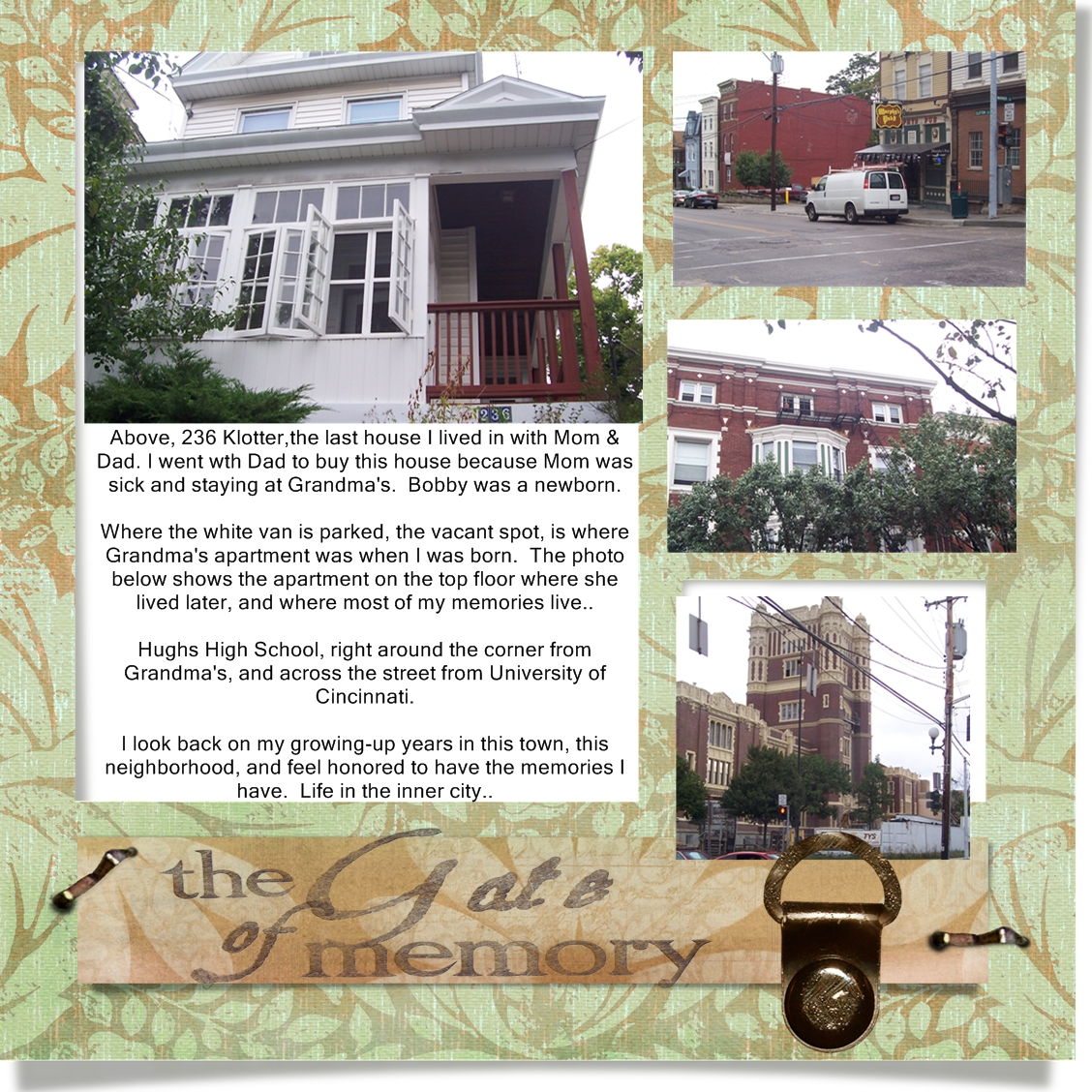
I look at these photos now, and age has given this place a whole new life. Our house on Klotter Avenue. I had a full teenaged life there. The memories are there, still living within the walls, and I can almost hear them whispering to me as I stand outside on the cracked sidewalk. From the second-floor bedroom shared with my sister, we could see downtown Cincinnati lights along the Ohio River at night. If we walked to the top of Clifton Hill we could visit the musty, shelf-packed bookstore, eat a Papa Dino’s pizza across the street from my highschool. Or we might head on over to Lendhardt’s for some German food, and maybe I’d run into Krista Lenhardt who came into my second-grade classroom at St. George straight from Germany, and we helped her learn English. We could decide on Indian food, Greek or just about any other. The Bearcat Lounge is still there if we were in a mood for some hearty dark lager.
When we were younger, we could drop in and see Grandma. You’d have to push the button beneath her mailbox in the tiny lobby, and she’d ask, “Who’s There?” as she did every single time in her high, sweet, sing-song voice. Once she pushed her button to open the door, you’d have to make sure you turned the knob while she was holding the button down, or else you’d have to start all over. Once inside, you’d trudge up three flights of steps, passing Uncle Clarence and Aunt Marie’s apartment on the second floor landing. They always heard your shoes heavy on the wood steps, no mater how quiet you walked, and they’d come out and visit for a while. You could look up the steps and see Grandma’s house slippers on the top step waiting for you. She was patient, though, because Clarence was her brother. Aunt Marie liked to show you how her parakeet would sit on her tongue. I never understood that.
“Each of you carries within yourself a ‘postage stamp of native soil,’ a ‘sense of place’ that defines you. It is the memory of this place that nurtures you with identity and special strength, that provides what the Bible terms “the peace that passeth understanding.” And it is to this place that each of us goes to find the clearest, deepest identity of ourselves.” By William R. Ferris (Chairman of the National Endowment for the Humanities. This article is adapted from a 1996 speech he made to the Commonwealth Club of San Francisco.)
Reading William Ferris’s words about being endowed with “identity and special strength,” I can now see how my place influenced me after all these years.
Belonging to More Than One Place
After I moved to Tennessee in the summer of 1968, a new life began with more twists and turns than I ever expected. Getting settled in not just a new state but, to me, an entirely alien way of life was both exciting and disturbing. My accent, which I didn’t know I had, was made fun of. If I said I wanted a “pop,” everyone laughed. It was a “cold drink” here. One day I heard someone say “La-FAY-ett” for Lafayette, accent on the fay. I wondered if these people had not studied history in school.
The beauty of the landscape, however, in stark contrast to the concrete jungle of metropolitan big city, awed me. The friendliness of the Volunteer State people (aside from the jokes about speech) was heartwarming. It wasn’t long that I lost my homesickness and became part of a new southern culture.
The music business of Nashville had brought us here, a husband who loved the recording studio and business of music, but after 20 years of marriage we ended in divorce. Fifteen of those years were lived in Tennessee. My choice was to stay where I called home, where I had a son-in-law and a grandchild. Where my new career as a court reporter was beginning to flourish.
A Place of My Own
I’d married young and stayed married half of my life. I was ready to meet the world on my own terms. My ex was the type who divorced not only his wife but his whole family. No matter, I preferred being the head of the family and went on to create my own sense of place for my children and grandchildren. After at least 10 years of abject misery in the marriage, I pursued having fun as my favorite pastime. My home was peaceful for the first time in my life, having been raised by loving parents but in a dysfunctional and sometimes volatile setting.
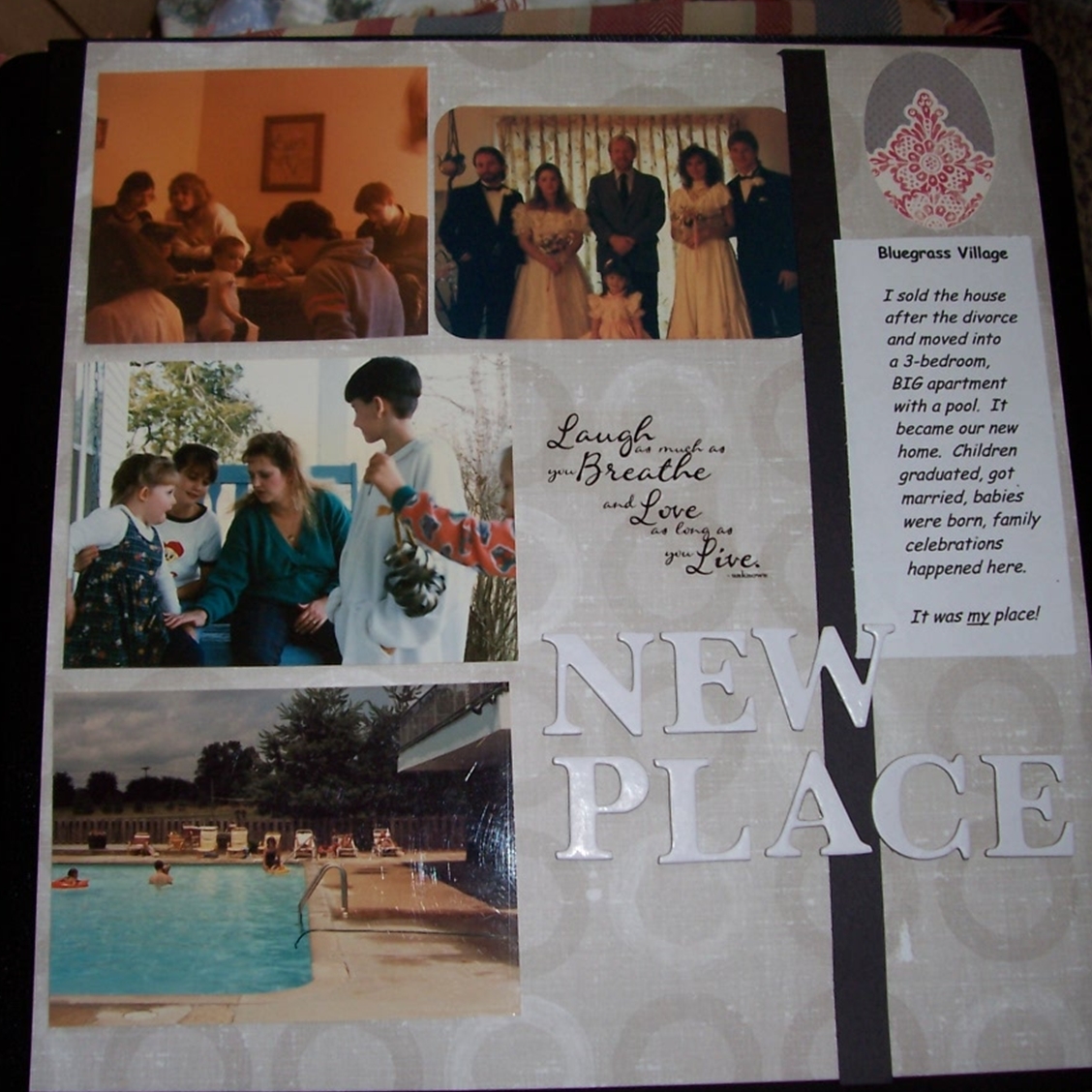
I worked, enjoyed life, went on trips with girlfriends, spent money how I wanted, answered to no one. I dated some losers and found out all the good ones were already taken and concluded taking up a new hobby was a good thing.
I enrolled in our local junior college’s photography class and went out and bought myself a sleek SLR and began snapping pictures of everything in site. Perhaps, I told myself, with the children pretty much raised, in a few years I might get in a little sports car and head off for places unknown. After all, I could be a court reporter anywhere there were lawsuits.
As with many best-laid plans of mice and women, the man intruded into my life. The rest, as they say, is history. There was yet another chapter to my story, and turns out, 22 years later, the best was undoubtedly yet to come.
A Resting Place
I don’t mean this subject header to imply a final resting place, as in a cemetery, because that is certainly not the new life I embarked on with my new husband. Rest is a good thing when you’ve grown up taking care of yourself, first as a child when your mother is sick so much, and then in a marriage where you must flee with your children from time to time. It took some getting used to—having someone who wanted to take care of me. And I’m not one of those feminist types who take offense at a good man making me feel secure. I basked in the glow of it. I soaked it up like a late summer flower in the dust.
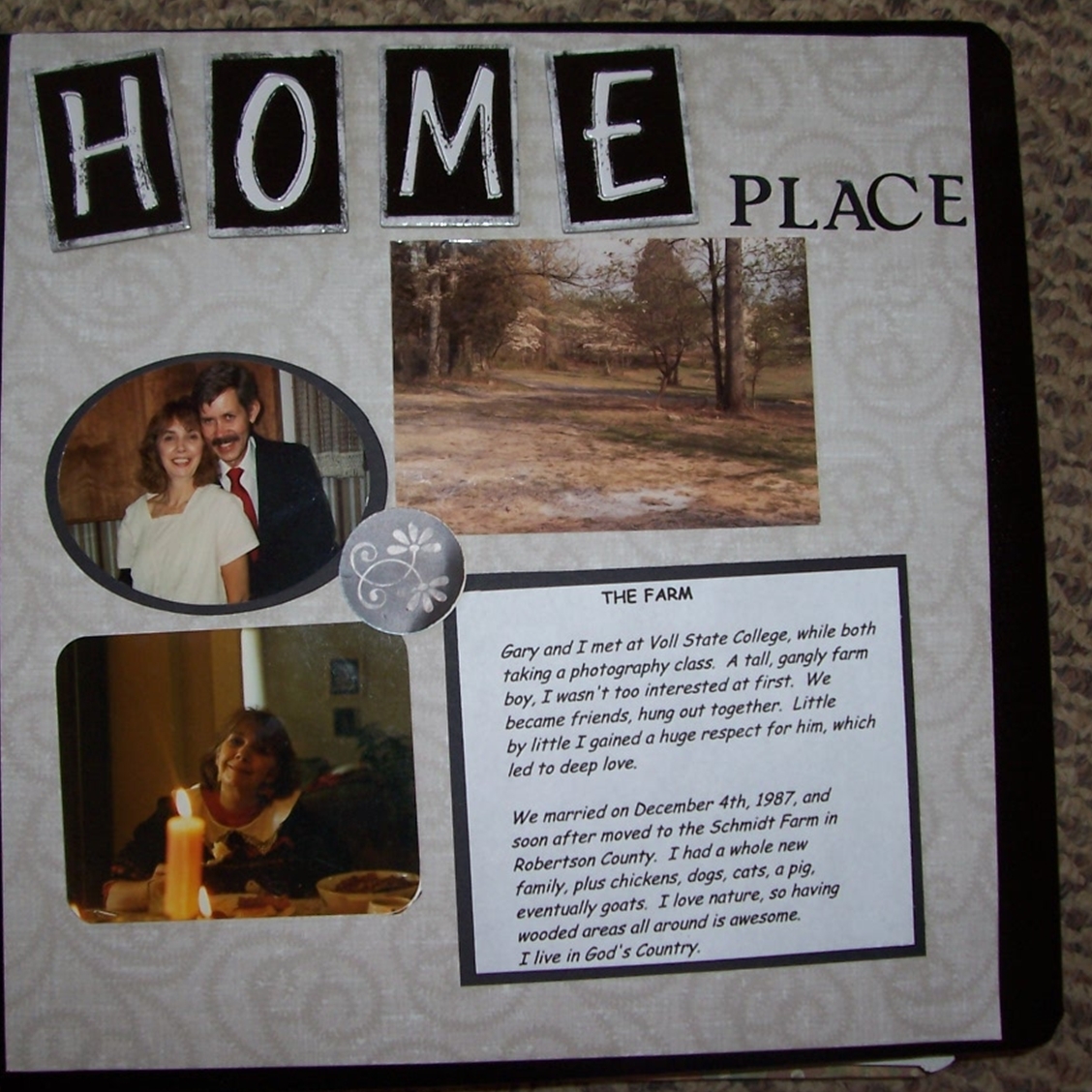
My new place then became a 250-acre farm about 25 miles northwest of Nashville, owned by the Schmidt family since the 1800s. This city girl had a lot to learn about living the close-to-the-earth, simple life.
Coming Together
My sense of place now, on a day-to-day basis, is the farm, the woods, the animals, growing, preserving, cooking.
My old home in the inner city, Over the Rhine, is still an intricate part of me. It’s where I learned to take care of myself. It’s the place that taught me who I am, what I could endure, the beginnings of a person inside who would someday emerge in the place intended.
My own place, with my children, grandchildren, the early standing-on-my-own-wobbly-legs years, plays a part in my place memories. That’s when my self-confidence began to take hold, when I found out a woman alone with children wasn’t always a statistic. Despite the cruel treatment and even crueler words from the marriage made in an attempt to subvert my sense of self and keep me helpless, I recognized an innate intelligence to make a life worth remembering. I believe now this sense of place is inside you, inside your soul. It can be the space you live in alone, like my grandmother in her later years, where she took good care of herself, enjoyed simple pleasures. It’s the life you make for yourself, the people who’ve helped mold you, the memories you cherish, the lay of the land and the architecture of your past and present.
Where is your sense of place? Is it a real place or a feeling? Do you have any images that speak of it? How can you incorporate place into your scrapbook, family history, or memoir? Please let us hear your comments. And if you need help with a project, I’m available.
Bettyann Schmidt
http://journey2f.blogspot.com
memoir writing
memoir vignette
memoir scrapbooking