Post #75 – Women’s Memoirs, Book & Video Raves – Kendra Bonnett and Matilda Butler
Reviewed by Lanie Tankard
If you’ve spent time in a cancer-treatment center, TALES FROM THE PAGER CHRONICLES: Volume II
An Intriguing Device
Patrice Rancour, a nurse behaviorist, has sketched a day in the life of her job. That day is September 11, 2001. Sequential vignettes show cancer patients and their families interacting with hospital personnel. Rancour plays a role in each event, sometimes summoned and other times encountering people in halls, lobbies, or elevators. Situations shift as Rancour’s pager buzzes — thus, the book’s title. She wonders what movie is on TV as she glimpses images of planes flying into buildings, but has no time to ask because the cancer dramas unfolding around her are nonstop.
Rancour is a manager with the in Columbus, and has been in her vocation for more than thirty-five years. many academic papers, including one chapter on dealing with angry patients and their families in an edited handbook of clinical teaching. And many people in The Pager Chronicles, Volume 2, are angry.
This book calls itself a “creative nonfiction account” on the back cover. Rancour explains her literary method in an Author’s Note: “It is in the nature of creative non-fiction to be more interested in reaching into the heart of the truth, rather than in providing a mere exposition of the facts.”
Of course, the (HIPAA) protects “individually identifiable health information” under federal rules, and Rancour assures that “confidentiality is paramount.” She uses fictitious names, and clarifies her writing approach:
“Often circumstances have been intermingled to give composite illustrations of clinical experiences taken from my years of work….While portraits are representative, individual privacy has been protected….It is in this spirit that I beg forgiveness from the reader if any incidents seem familiar as it is because these experiences, while unique to each individual, are not unusual.”
The hospital is apparently a metaphor as well.
Valuable lessons are recorded in these archives. The medical profession can learn a great deal about patient/family relations during both care and death. The general public can find out a lot about cancer treatment.
Clinical terms defined in a Glossary at the end are underlined on pages where they occur, which I personally found distracting (especially on page 35 when six appear). Brief explanations woven right into the narrative or footnoted on the same page might smooth the flow.
Memoir writers with deep specialized knowledge of their fields face structural dilemmas. Who is my audience? Am I writing for peers or public? Am I composing a clinical handbook or a literary creation? Can I do both?
Rancour seems to be employing the broader reach. She includes two sets of Journal/Book Club Questions at the end — one for healthcare professionals and students (such as “How do you balance the demands of a personal life with the demands of a professional one?”) and one for the lay-reading public (such as “What lessons does the illness have to teach you?”).
Rancour’s mission is significant but difficult. She maintains a professional tone while holding a mirror to procedures that lay readers might never have encountered, although on occasion with perhaps a tad too much detail.
“It’s another day at the hospital,” she says. To me, that drama alone is riveting enough. Placing these heroic cancer tales in the shadow of 9/11 feels unnecessary. They don’t need the backdrop of extra drama from outside. There’s enough inside.
Framing literature in historical events succeeds only if the theme is consistent. Planes hitting the Twin Towers are mentioned on page 18, but not again until page 82. That’s a long gap. What is the book’s focus? Is it a nurse’s memoir, a clinical guide to working with cancer patients, or a 9/11 journal? If a journal, “9/11” is used to label unfolding events, when that term actually did not evolve for quite some time after the day.
The assumption seems to be that the audience has already read the first volume — Tales from the Pager Chronicles — and that this second volume is more of the same, except it supposedly happened on 9/11.
Volume 2 differs from its predecessor in several ways, however. The sequel could benefit from additional editing so that we would have more of the poetry and verve of the previous chronicle. What seems to be missing is a feel for the arcing of the sun overhead, the unfolding of a day, from morning to noon to sundown. The author leaving her home, her thoughts driving to work, her arrival — all would have brought the reader to the hospital along with her. Instead, the book begins abruptly: “After the in-service, the OR nurses and technicians amble out of the conference room….” It does wrap up nicely, though, with Rancour sitting in on a class about Death, Loss, and Grief at the end of her workday, contemplating the students around her. How does she make it through the day? The times when she pauses to process and share her feelings feel good. More introspection, please!
Still, these caveats are minor, although henceforth I’ll be on my best behavior in medical settings. And yet, isn’t anger sometimes justified? Cancer is devastating. Certainly we should not have to worry about how we might be perceived when making decisions about our own lives or those of our loved ones. Indeed, patients and caregivers could write similar chronicles from their viewpoints.
Rancour has had the courage to bear witness to this cloistered world. When I’ve been a frustrated caregiver, there was always someone like Patrice Rancour around to help me advocate for a loved one. Various social workers listened and immediately went to appropriate personnel to change situations. Therapists taught us yoga and tai chi to relax. Others massaged our weary bones. Once, an entire cancer treatment team created a retreat in the woods so families could leave the Big C behind for a weekend.
And then, at journey’s end, a hospice worker simply sat and held my hand.
The Patrice Rancours of the world are out there to assist, trust me. And their roles are vital. So are books like this one, to enlighten us all.
+++++++++++++++++++++++++++++
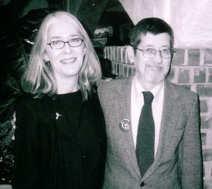
Lanie Tankard and her husband at an American Cancer Society luncheon. Dr. James William Tankard, Jr., was professor emeritus of journalism at the University of Texas–Austin at the time of his death in 2005. A nonsmoker, he battled lung cancer for five years.