Post #128 – Women’s Memoirs, Writing Prompt – Kendra Bonnett and Matilda Butler
Writing Tips: How is Writing a Memoir Like Making a Good Video?
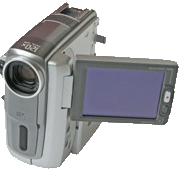 I hope the question above has made your curious and opened your mind to a different way of thinking about your memoir.
Yesterday, I mentioned that last June, we helped Kendra celebrate her upcoming 60th birthday — one she seriously wanted to avoid. Since the only way to avoid it seemed like too drastic a step to take, we decided to help ease her into the next decade with a Fabulous, Final Fifties Fling. During our weeklong trip, we made many stops and saw some wonderful sights. But today I want to focus on an article I read in Southwest Airline’s Spirit Magazine (June 2011) on the flight to meet up with her.
Since I use my Flip Video Camera frequently, I eagerly turned to a short article called “Straight Shooter.” It was designed to give a few quick pointers about making “vacation videos worthy of viewer attention.” Once I read the advice, I quickly saw how this also applies to memoir writing.
1. Focus on the Story. Yes, that was one of the headlines. The videographer was cautioned to focus on people, including interviewing them, rather than scenery and passive scenes, saying “answers are often the most memorable part.”
For memoir writers, we need to consider our dialogue — ensuring that it is true to the way people talk. Did your mother have a favorite saying? Work that in. Does your partner have an accent? Don’t overdo it, but add a little so that the voice is true to the person. Interviewing people for a video or writing dialogue to tell what happened for a memoir are ways to let the story shine through.
2. Keep Shots Short. The article said, “Like sentences, shots are the smallest units of film with both a noun and a verb. Keep them concise–there’s rarely a reason to run the camera longer than 10 seconds at a time.” That’s a great reminder for memoir writers that dialogue needs to be short. Rarely do we allow the other person to go on for a long paragraph. We know how tempting it is to use dialogue to state long material. It just doesn’t belong there. Don’t believe me? Go listen to some dialogue. Take a pad with you and jot down what is said. If you’ve never done this, you’ll be surprised.
3. Get Close. I really like this advice. And while the article said that “Faces connect us,” I think we can expand somewhat. Details connect us as well as faces. What do I mean? First of all, faces are often left out of memoir writing. Too often the memoir writer assumes the reader knows what the person looks like or thinks it doesn’t matter. Yet, if we want the reader to “see the person,” there needs to be adequate description. Second, details of places also help the reader to feel that she is there. I like another piece of advice from the article — “A wide shot of someone walking communicates action, but it doesn’t communicate emotion.” You need details to share emotion with your readers.
When you sit to write today, pretend you have a camera in your hand. What is your focus? What is your dialogue like? How close to the story are you taking the reader through the details you provide?
Remember, you want a story that is worthy of reader attention.