Post #170 – Women’s Memoirs, ScrapMoir – Matilda Butler and Kendra Bonnett
Memoir Writer Recalls a Valentine’s Day Past
Occasionally, Women’s Memoirs receives a story that we think deserves special attention. Today’s memoir vignette by Sara Etgen-Baker is one of those. It isn’t a story with hearts and chocolate, with romance in the air, with fond memories. But it is a story of growing up and becoming wiser when life takes her by surprise.
We invite you to leave Sara your thoughts on her story in the Comments section below.
JOURNEY ON VALENTINE’S DAY
by Sara Etgen-Baker
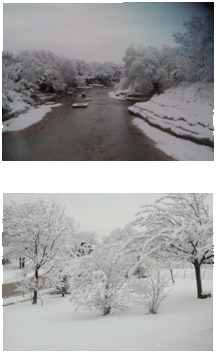 A sharp, bitter, wind howled around Smith Hall blowing sharp ice pellets against my dorm room window. I peeked through the curtains and noticed that graceful flakes of lace and crystal butterflies had blanketed and subdued the tree-lined courtyard below. I quickly dressed and headed downstairs toward the main door hoping to take advantage of this seemingly perfect winter day by making a solitary drive through the countryside.
As I stepped outside, I watched my warm breath mingle with the crisp, cold air as it stung my cheeks. The gentle snow crunched under my boots as I walked toward my car. The mercury had dipped well below freezing that Valentine’s morning leaving a layer of pearly-white frost on all the car windows in the parking lot. Daylight had not yet turned the slumberous, dark blue clouds to their morning gray, and—for a moment—I lingered outside my car not wanting to disturb winter’s peaceful silence.
After only a few minutes though, I’d left the well-lit highway and found myself meandering down poorly-lit roads through the East Texas countryside. My headlights reached out in the dark ahead of me making the snowflakes look like stars sliding by faster than the speed of light. I inhaled the sweet, heavy smell of smoke emanating from log fires. Soon, winter’s tranquility and purity surrounded me—naked trees, crystal glints on snow, and icy ponds cloaked by frost-covered pines. I found East Texas simply breathtaking in the wintertime.
I embraced the subtle privacy of driving through the wintery countryside with its longer, quieter stretches of road where I could savor belonging to myself and could come to grips with the truth. So, I stopped my car as memories of my fiancé gradually drifted by on a blustery breeze—reaching out for a grasp on this perfect moment. Stillness set in until I felt alone and desolate. In that winter darkness, I slowly discovered that things are reduced to essentials—the bones of the land, the bones of the trees, the bones of truth, and the stark elegance of the underlying structure of life.
I escaped into winter’s magnificence seizing the silence around me until I once again heard my fiancé’s words—those icy shards of truth—as they cut through my heart and wrenched my spirit leaving me stunned and frozen.
“I need to talk with you about our future,” he said over the telephone. “I just can’t live a lie anymore; doing so would be unfair to us both. I know that I love you and believe you deserve the truth now rather than discovering the truth after marriage.”
“What are you talking about and why all this ambiguity?” I inquired.
“Um….um…umm,” he hesitated. “…I’m pretty sure that I’m gay.
“What?” I angrily replied.
“You see,” he continued, “I have to be me; and, although I love you, I can’t marry you.”
The telephone in my hand felt as heavy as my disbelief as I struggled with what to say. “I suppose you have to be who you are—that much is true. Right now, though, I don’t know what to say to you or how to react. I need to hang up; but before I do, you should know there’s a space that only you can fill…I love you and always will.”
He hung up the telephone. Then—silence—powerful silence.
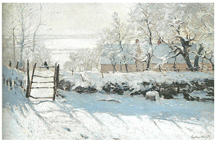 The truth—magnificent truth—was now somewhat easier to grasp here in the gentle splendor of the wintery East Texas countryside. Just before leaving the country roads and turning onto the main highway, I looked in my rearview mirror noticing that daylight had transformed the countryside into a soft Monet-like landscape painting. Serenity washed over me leaving me refreshed and ready to return to campus.
I returned to campus, attended my morning classes, then stopped by the campus mail station to pick up my mail. When I turned the key to my post office box and opened the door, the contents—small red and white children’s Valentine envelopes—spilled onto the floor in front of me. As I scooped them up, I counted them—exactly 100 tiny envelopes—each bearing a six-cent stamp and meticulously addressed to me in my father’s handwriting.

When I opened the envelopes, I discovered that he had signed each Valentine with “Love you, Dad.” In some envelopes I also found a special surprise such as a piece of chewing gum, a quarter, a one-dollar bill, a five-dollar bill, and even one ten-dollar bill. On some cards, he wrote encouraging quotes like:

“You’ve outgrown my lap but not my heart.”
“Take comfort in your strength.”
“You’ll one day find someone special to capture your heart.”

“You‘re beautiful and precious in my eyes!”
“You’ll survive….”
 I wept uncontrollably, though, when I read this quote:
“One hundred hearts would be too few to carry my love for you.”
My father’s words and actions washed over me exposing an important truth—that I was uncommonly strong, beautiful, and the most precious thing in his life. Thanks to my father on that Valentine’s Day I learned that truth—magnificent truth—is as inescapable as winter and an essential part of life.

{ 0 comments }