Post #10 – Women’s Memoirs, ScrapMoir – Matilda Butler and Kendra Bonnett
We’re pleased to bring you the third guest blog written by Bettyann Schmidt. She begins with two powerful family stories, complete with treasured photos, and then gives you a writing prompt. Try using it and combining what you have written with your own photos. Before you know it, you’ll have a series of your personal ScrapMoirs.
WRITING TO HONOR by Bettyann Schmidt
Your family history is not meant to be painted in broad brush strokes, summing up the meaning of the millennium. It is a description of your living room, of your grandmother’s living room. — One Memory At a Time, D. G. Fulford

My grandmother
Fulford’s quote eloquently sums up most of my childhood memories. Clara Wehrle Dean and I had a strong relationship. I was the oldest grandchild of many more to follow, but I believe in her heart, I was somehow special to her. She endeavored to mold me into her likeness and to mentor me. I never lost my connection with her, even as teenage and adult years carried me to different places far from her physically.
Grandma and I could talk. About everything and nothing. It was not just grandparent to child, even in the early years. Real talk. Making-sense talk. This facet of our relationship is one I’ve strived to enjoy with my own granddaughters. There are times that a grandmother’s open ears and nonjudgmental heart are needed. Even better than your best friend, because your grandma can actually do something about the mess you’ve gotten yourself into sometimes. My grandma helped me sort through my feelings like no one else on earth.
The memories of Grandma’s small, third-floor walkup apartment on the corner of McMillan Street and Clifton Avenue, a hubbub of city life, is as vivid in my mind as if I was there now. I always sat in the floral chair, and she on the matching sofa. The pink and blue roses on a pure white background always liked new, even though the fabric wasn’t. Grandma was fastidious and took good care of her things. She kept clear plastic covers on the furniture for a few years, but even when they came off, the roses looked as if they had just opened on a bright summer day. The coffee table in front of the sofa as well as a low end table against the far wall were covered with Roookwood pottery because she’d worked there after her children got older. She allowed me to play with her small figurines, but warned me if I broke even one I wouldn’t be able to play with them again. I never broke one.
Sometimes she’d send me downstairs to the German bakery for a cheesecake, and we’d eat slices on old, dessert plates in an assortment of patterns. We sat at her white wood table in the kitchen. If it was winter, her ivory enameled gas stove’s oven door was open. It was the only heat she had.
We liked to listen to Bill Dawes on the radio in the mornings and the popular songs that played in between his news and announcements. After breakfast, each of us would take a “bath” at her wall-hung sink in the kitchen. The only bathroom held just a toilet. Grandma taught me how to wash every part of your body at the sink starting with your face and working down. Then we’d get dressed. Grandma always wore a crisp, clean housedress and stocking with garters, the old-fashioned, elastic-band type that slipped over the stockings and held them in place around the thighs. Grandma would then roll the her stockings wrapped around the garters down to her ankles and put on her house slippers.
After dressing, every single day, Grandma applied makeup and fixed her white, thin hair, permed in tight little curls at the beauty shop every six months. She said the style hid her scalp. She sat at the kitchen table with a two-sided mirror, magnifying on one side and regular on the other, with powder, rouge, eyebrow pencil, and dark red lipstick. She even dabbed a bit of Evening in Paris cologne behind her ears. Grandma cared about herself.
My grandmother wasn’t an all-over-you, huggy person. She had her boundaries, her personal space that she didn’t let everyone invade. Maybe that’s one of the shared traits that bound us, or maybe that’s how I learned to be that way because of her. But Grandma loved me. Of that there is not a doubt. Everyone else knew it too. At her funeral, my Aunt Dorothy said of her mother, “She loved you so much, Bettyann.” I replied simply, “I know.”
If someone can make you feel such a sense of love in just being with you, teaching you, and talking to you, that person needs your words in tribute. My Grandma is one of those people. Perhaps the largest gift she ever left with me is the story of who my father really was and the family stories she kept inside just bursting to get out and make a lifelong impression on a raptured young girl who would treasure the memories her whole life and pass them down to her own grandchildren.
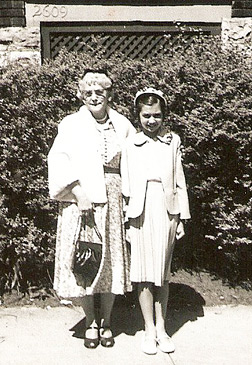
Grandma and me on Easter
In this photo, circa 1954, I’m standing with Grandma on Easter Sunday, on Sander Street, across from our house. Note the Easter bonnets. Easter was an important Catholic holy day and a day of celebration. Grandma always came to our house for dinner after mass.
Frank and Clara
Grandma told me a single story more than once. It defined her in some way to herself and gave her a sense of direction. I’d like to share that story with you.
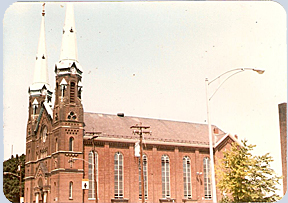
St. George Church -- one of the earliest Catholic churches in Cincinnati, built in the 1800s, the Dean and Wehrle family church. The school was across the street, where my father and his siblings attended classes in the 1920s and ‘30s, and where all of us children went to school as well.
It began in 1919 when Grandma married Frank Dean, a Catholic boy whose home was the city streets. The Catholic Church and her faith, as you’ll see, meant a lot to Grandma.
A Dapper Dan type, Frank cast his spell over Clara and whisked her away to a second-floor apartment in the Over-the-Rhine area. It was named by the early German settlers because the old Erie Canal reminded them of their beloved homeland’s Rhine River, and to get to the downtown business section, one had to cross “over the Rhine.” Frank and Clara’s apartment on Clifton Avenue was just steps from the the Prosit Bar, where most nights found Frank enjoying the revelry of the city street life, which he was never able to give up.
When the abuse started, as it usually occurs, women tell themselves, it was just this one time, and he’s sorry now. Then it happens again and again, and pretty soon it has become a way of life. You birth your children and they enter your way of life. If you believe yourself to be a good Catholic wife and mother like Clara Wherle Dean, you endure.
Clara became, over the years, leery and astute to Frank’s footsteps on the stairs. After the birth of their fifth child, he stayed away for days, then sometimes weeks. He’d show up out of the blue during the depths of the Depression, looking for and stealing any funds Grandma had stashed away and leaving her bruised and broken.
One day Frank’s oldest child, Raymond, my father, age 12 at the time, could no longer tolerate the abuse. When his father showed up the day that was to become the last time, my father threw him down three flights of steps at the apartment they lived in then and warned him never to come back again. And Frank stayed away. My Grandma thought Frank knew he’d fathered a son much stronger and moral than himself and his boy meant what he said.
In 1950, 18 years later, Frank resurfaced. He showed up at our house on Sander Street. Grandma came over when Dad called her. But she stayed inside looking out the living room window and refused to go outside and meet with her husband standing on the sidewalk. I stood at the window with her and looked out on a man I’d never met or known. His swarthy complexion and dark hair threaded with gray was the image of my father. His stature, though, was smaller than Dad’s. Moreover, I knew that inside, where it counted, he was nothing like my father.
Dad begged Grandma to come outside, but she refused. “Raymond, you remember I swore I’d never let myself be in the company of that man again, and I meant it.”
Grandma had made this vow when it got back to us that Frank had married and began another family even though Grandma never gave him a divorce. It was a sin. Short and simple. The Catholic Church did not allow it. Grandma stayed married to Frank the rest of her life.
The stranger who was my grandfather was not what I expected. He wore a pinstriped suit and white shoes, a straw hat on his head. No one I’d ever met dressed like that, except people in movies. Grandma moved her head from side to side. “Oh, Frank always was the Dandy.” Her eyes held a mistiness that came when she told me stories of her early family. The good memories. I wondered if she was thinking of a good memory of Frank, and if there really were any.
I never saw my grandfather again, but one night shortly after he’d visited, Dad got a phone call from a hospital. Frank was dying of cirrhosis of the liver. I guess that night he came to the house because he knew he was leaving this world and wanted some atonement. Sadly, he never got it that night from Grandma, though I know she forgave him in her heart. But when Dad begged the priests to give him the last rites of the Church, they refused because of his unlawful second marriage. Dad cried that night when he came home from the hospital, and in the next room I heard him telling Mom how he’d begged the priests to come. Clearly, Dad had forgiven his father, and I’m pretty sure Frank forgave his son.
The day of the funeral, Grandma stayed with us kids while my parents went. No amount of begging changed her mind. She sat with me on the old, faded pink frieze sofa in the Sander Street house and explained how being a good Catholic meant following the rules even when everybody told you otherwise. People, even her own children, had tried to encourage her to divorce Frank a long time ago. Under such circumstances I would have, and did in fact, get a divorce, but I’d long left the Catholic Church by then.
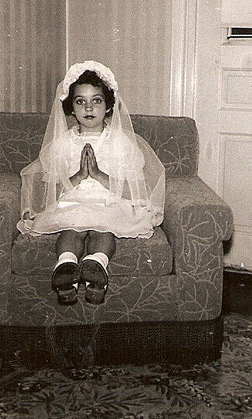
My First Communion day. Grandma gave me my first set of real pearls, an expensive gift she must have saved money for every month out of her social security check, her only income.
Who Are the Mentors in Your Life?
We were presented with an exercise of this type at a scrapbook conference several years ago, and I immediately chose my grandmother Clara as my best mentor. Then we were told to write a tribute to this person, remembering all of the important lessons you learned, what you remember most. We were instructed to describe that individual, his or her character, morals, beliefs, values, goals.
SCRAPMOIR EXERCISE:
1. Make a list of people in your life who were mentors in some way, who changed you, who still live in your memories, and then pick one to start with.
2. Remember to envision the living room of the person you want to write about and see where that takes you.
3. Find photos to add to your story. Be sure to document the people and places in your photos.
Bettyann Schmdt
http://www.bettyannschmidt.com
http://www.journey2f.blogspot.com