Post #84 – Women’s Memoir Writing, ScrapMoir – Matilda Butler and Kendra Bonnett
Women’s Memoirs is pleased to present the second in a three-way tie for First Place in our April memoir contest — APRIL MEMORIES category. Be sure to check back all day as we continue to publish these stories.
JOURNEY TO AMERICA, APRIL 1, 1940
Phyllis Mattson
April 1, 1940
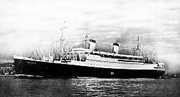 Early morning on that overcast day, my ship, the SS Washington, entered New York Harbor welcomed by the Statue of Liberty surrounded by a skyline of huge skyscrapers. On that day, my life would change forever.
Passengers, many also escaping from Nazi-dominated Europe, crowded the deck. My mother had told me about the famous sights as she prepared me for my solo journey to America. She told me it would be a great adventure, and I should write her all the details. She would be coming soon, and we would be reunited with my father, already in England, who had been forced to leave Austria the year before.
I am ten and a half, the youngest of our group of ten children. On March 20 we had left Vienna escorted by a lady unknown to us. The train was packed with somber people fleeing persecution, some crying, clutching their food and few possessions for the two-day trip to Genoa, Italy, where our group would board our ship. The seats on the train were wooden and uncomfortable as the train lurched causing me motion sickness. I ran to the toilet often to throw up. In Genoa we stayed in a hotel–my first ever.
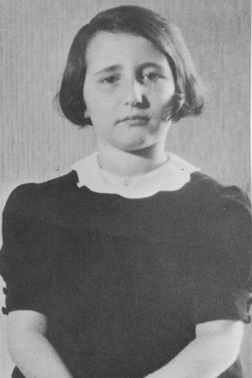
My passport picture
Unlike the train, the ship was astounding in its elegance. Crystal chandeliers and beautiful furniture were new to me, but it was the food that was especially great. We’d had so little since Hitler occupied Austria two years before. The ship was fun as it rocked gently in the Mediterranean the first two days, but when we entered the Atlantic, seasickness kept me confined to the cabin I shared with another girl.
The ship docked and everybody rushed to get off. Some nicely dressed ladies from the Jewish Welfare Committee that had sponsored our immigration greeted us. They were friendly, but I could not talk to them because I only knew a few words of English:
Thank you. Please. How do you do. Good morning.
A taxi took us to the George Washington Hotel on 23th St. in Manhattan. I had never been in car before. In Vienna, there were few cars. I liked riding in this one. America must really be a rich country, I concluded, because the streets were full of cars and so many big buildings. Even the hotel was a skyscraper. Much nicer than Genoa. Red carpets, fancy chairs and tables, gold on the pillars in the lobby, wow. Then we went up the elevators, high, high; my stomach stayed behind, almost like getting seasick. I shared a large, beautiful room with another girl, surprised by the big bed just for me. In Vienna, I still slept in a crib.
The dining room at the top of the hotel was another magnificent room, like the palace rooms in Cinderella. The tables had pink cloths, fresh flowers, and exquisite stemmed glasses. The Negro (the word we used in 1940) waiters in white uniforms served us sophisticated food elegantly. I had seen a Negro only once in Vienna; people on the street had pointed at him because he was strange, and I had stared. Now, I smiled at the friendly waiter putting the napkin on my lap; I didn’t know how to be proper in such a fine place.
Then the welfare ladies took us to Rockefeller Center, one of those super high skyscrapers I had noticed from the ship. Now we had to take two elevators to get to the top, leaving my stomach behind and causing my ears to pop. It was breathtaking to be on the 70th floor looking down on the street where the cars looked as small as ants. One building, the Empire State Building, was even higher than ours.
Next we went to a giant theater, still at Rockefeller. We saw a movie, Pinocchio; followed by many beautiful ladies, the Rockettes, dancing in a long line, all doing the same thing. I had been to only a few movies in Vienna — mostly Shirley Temple, but no dancers, and this theater was so much bigger. Everything in New York was big.
Then to a restaurant for some sweets. An ice-cream soda was ordered for me, causing a funny tickle when the soda came up my nose. I loved ice cream, always my reward for good marks in school. A great day, one adventure and thrill after another.
April 2, 1940
I was put on a train to begin my journey to San Francisco where I would live with a distant relative. I was the only child to go to the West Coast, the others stayed in the New York area. Now I was really alone, couldn’t speak English, didn’t know what would happen next, but I was not worried; I was excited about the new wonders I would see. Somebody was my guardian –perhaps the porter — because I was taken off the train in Chicago to sleep at the Palmer House Hotel, resuming the train ride the next day.
On a soft, comfortable seat by myself next to the window, I looked at beautiful scenery — snowy mountains, tunnels and steep mountain sides. I had wonderful meals in the dining car, and I slept in a bed near the ceiling.
April 6, 1940
On a clear, sunny day, the train stopped in Oakland. I was put on a ferry to San Francisco. This time, instead of skyscrapers, I saw many hills. What beautiful sights. A famous bridge, shimmering water, hills covered with white, pink and blue houses. San Francisco was more enchanting than I had imagined. I felt very lucky to have come to San Francisco. If I felt anxious, worried, or lonesome during the journey, I have forgotten it, remembering only the wonder of America in those first days. Thanks to mother’s preparation for my journey, I had a marvelous adventure instead of a dreaded separation. Enjoying the anticipation of a new and better life, I did not look back.
I was not afraid of the future, sure that my mother would be joining me soon. I had no inkling that I would never see her again, poor victim of Hitler’s atrocities.
……………..
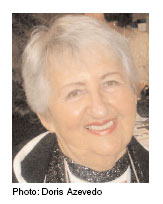 Author’s Note: I will never forget that April and continue to honor it each year. I celebrated it 60 years later, in 2000, in a special way — by having a huge party. With more than 100 friends, I commemorated my coming to the US. At that time, I read the first chapter of my not-yet-published book of my journey to not only a new country, but a new life. Their reception of it caused me to push ahead and finish the book: War Orphan in San Francisco: Letters Link a Family Scattered by World War II
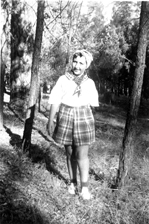
I went to camp that first summer in America.
memoir writing
memoir writing contest
memoir