Post #55 – Women’s Memoir Writing, ScrapMoir – Matilda Butler and Kendra Bonnett
by Bettyann Schmidt
In matters of principle, stand like a rock. ~~ Thomas Jefferson
Defining Your Worldview in Memoir and Scrapbooking
Children are taught from an early age what their worldview is, or should be. Some grow up as adults still seeing the world as they were taught, and others experience lives in a manner that change their views. Some fortunate little ones have open-minded parents who raise their children to think for themselves and challenge their minds to live in a changing world.
I might be a mixture of all of the above. My schooling for ten years was Catholic, and my extended family members were loyal to their Church’s beliefs. During my tenth grade at Our Lady of Angels high school, I began questioning religious instruction. I rebelled against some of the Vatican’s rules, for instance their stand on choosing whom to save during childbirth if such a choice had to be made.
Since my mother was pregnant with her sixth child, a late pregnancy to begin with, I wondered how the Church could condone saving a newborn baby who would not have a mother and have only a father, a blue-collar worker, left alone with six children to raise.
For a teenager, this became a weighty issue and a source of anger and questioning right and wrong.
I never admitted my lack of faith to anyone, particularly my grandmother, who would have become upset to the point of possible illness. Nor did I want to worry my mother with a decision I hoped she would never have to make. Instead, I cunningly wrangled my way into public school and refused to think about what I didn’t want to believe in, though I did remain Catholic and continued to attend church regularly.
Eventually I got married and had children, just like all of the other females in my family. My marriage, however, didn’t follow the path of those I saw as “good.” I married the wrong man, even though Grandma approved of him because he was Catholic. I learned that not all Catholic men turn out to be good husbands or fathers. I finally divorced after my grandmother’s death. I didn’t consciously think at the time I was waiting for her to die, but, in retrospect, I probably was. Perhaps her death was a statement. I could finally be free of a Church-sanctioned marriage turned bad.
These are just a few examples of how my worldview changed over the years into what it is now. My ideals, my values, my principles, at this stage of my life, have been formed from experience. I’ve learned not to be as outspoken as I once was on issues like politics, religion, the state of the world in general, but there remains one place I can state my beliefs, where I don’t compromise my strongholds. My writing. This is where I uphold my worldview.
Please understand that my layouts in this post express my own moral beliefs. I do not want anyone to take offense at my “stand” on issues, just as I’m happy to hear your comments on the issues you stand firm on. The point of this is to help you write those views into your own projects. Below I express my personal opinion about racism. I hate it. Where I grew up molded that worldview.
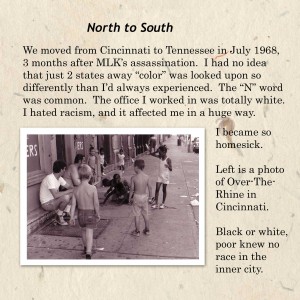
Above layout photo of Over-the-Rhine courtesy of
Christopher King, http://KingCast.net
Lifewriting’s Worst Enemy in Memoir and Scrapbooking
And by the way, everything in life is writable about if you have the outgoing guts to do it, and the imagination to improvise. The worst enemy to creativity is self-doubt. ~Sylvia Plath
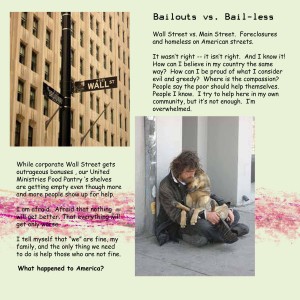
In writing for scrapbooks, I’m one of a piddling few who tell stories that are not all happy and serene. I do celebrate the fun times in my albums, but leaving a legacy where I deliberately omit anything but good times makes me a traitor—to myself and my grandchildren and great grandchildren.
Does that command me to depict every spoiled memory, spill the ink on every bad story? Not in a scrapbook. But I do honor what I see as my moral obligation to tell small “tell-tale” vignettes, perhaps leaving out the most hurtful passages, especially if the story can be told without them. When I think about some of those stories and hold them up to the light from my window, I come to conclusions on what I can take away and still write an intact memory. This eases my self-doubt.
For my memoir, which is apart from my scrapbooks, a physical “need” inside me wants to tell the stories intact. Not placing blame on anyone, but summing up how the event affected me, changed me, guided me somewhere I’d never gone before, spiritually or physically. I feel memoir calls for this truth. And it must be true. If I don’t remember exactly how the scene unfolded, I will not tell it, or I’ll write that reservation about memory lapse.
Don’t rummage around in your past — or your family’s past — to find episodes that you think are “important” enough to be worthy of including in your memoir. Look for small self-contained incidents that are still vivid in your memory. If you still remember them it’s because they contain a universal truth that your readers will recognize from their own life. ~~ William Zinsser, Excerpt: How to Write a Memoir
Memoir Writing and Universal Truths
One of my favorite memoirs is Mary Karr’s The Liar’s Club because I associate with her story. Not that my own story is as heart-rendering as hers, but because of how she wrote it. Blunt. Not dressed up in go-to-meeting clothes. Karr’s book brought forth associations for me hidden deep in my subconscious. She wrote a universal truth.
It seems to me that the problem with diaries, and the reason that most of them are so boring, is that every day we vacillate between examining our hangnails and speculating on cosmic order. ~Ann Beattie, Picturing Will, 1989
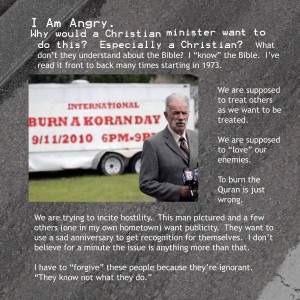
While everyday events, like “hangnails” or comings and goings in our small world, are fodder for our private journals, in writing a piece we expect others to read eventually, if only our family, we likely need to pay attention to the world around us. What is happening at this moment in time, and how do we feel about it? That’s how we take a stand, let our moral values take the stage.
One book that fits this criteria is the latest nonfiction by Susan Albert Wittig, An Extraordinary Year of Ordinary Days, where the author recounts her personal and global life during 2008:
As her eclectic daily reading ranges across topics from economics, food production and oil and energy policy to poetry, place and the writing life, Albert becomes increasingly concerned about the natural world and the threats facing it, especially climate change and resource depletion. Asking herself, “What does it mean? And what ought I do about it?”
An example of “global truth.” How we “feel” about what’s going on around us.
If it’s Big, Don’t Wobble
Now’s not the time to go wobbly, George. — Margaret Thatcher to George H.W. Bush, after Iraq invaded Kuwait
Writing a lifestory or a family history in a scrapbook or your memoir is a gigantic undertaking when you think about it. We’re preserving history for our ancestors, maybe for readers we’ll never meet. Our memories may get published. It’s not the time to go “wobbly.”
Standing by our beliefs is a big thing, and big things are scary. Asking questions about what is going on around us and forming our own opinions takes courage.
Every word born of an inner necessity – writing must never be anything else. ~Etty Hillesum, quoted in Ten Fun Things to Do Before You Die by Karol Jackowski
Your story, whether in a scrapbook or memoir, when it fiercely wants to come out and be heard, when it becomes an “inner necessity,” will be easier to tell. The memories harbored in the lake of your consciousness will swell up and fight to come out if that story needs to be told. If you’ve surveyed your world and nurtured the seeds of opinion and viewpoint, you will have a story.
As before, all comments are good.
Bettyann Schmidt
Be sure to join me on my blog:
Journey2f.blogspot.com
memoir writing
memoir
writing
scrapbooking