Post #54 – Women’s Memoirs, ScrapMoir – Matilda Butler and Kendra Bonnett
by Bettyann Schmidt
Language exerts hidden power, like the moon on the tides~~Rita Mae Brown
Creative Molds and Ordinary People
I’ve always been different. When I was a child, I was the only person in my family who loved to read, who had a library card. My father read the daily newspaper faithfully and worked the crossword puzzle, and he was a whiz at filling in every square–using a ballpoint pen. Possibly his literacy influenced his oldest daughter.
I wrote stories about children in families unlike my own, where the protagonist was always a girl my age who might be an accomplished ballerina, twirling around the stage at Music Hall, or working as a reporter for the Cincinnati Enquirer, whose bold headlined stories appeared on the front page.
The personalized mold from which I was cut showed up when I began scrapbooking, attending that first Creative Memories class. We were told to bring four or five “recent” pictures. I brought four of the oldest photographs I had, beginning with my Dad as a baby in 1920.
As we created our first page that afternoon , everyone around me at the table in the hostess’s dining room was writing one-liners under their pictures, like “On our vacation to Mexico in 1998.” I felt alone with my white 12-by-12-inch page that contained several paragraphs about my father. Beside the photo of him in his army uniform, I wrote the story of his being gone to war when I was born. I also wanted to document on the page who his mother was and where her family came from, thinking that if this was indeed going to be in an album that would outlive me, as the hostess had declared, then people might want to know something about this man other than his name.
Thus it began. Today 31 scrapbook albums stand on my shelves, many needing to be re-bound from being overstuffed. Half that amount likely would stand absent all of my stories.
The Difference in Scrapbook Journaling and True Journaling
While the scrapbook industry had traditionally used “journaling” to mean writing descriptions about your photos, to me this is a deceptive term. A few words under a picture is most often not even a sentence.
From Miriam-Webster: The word “Journal”
1. a : a record of current transactions; especially : a BOOK of original entry in double-entry bookkeeping b : an account of day-to-day events c : a record of experiences, ideas, or reflections kept regularly for private use d : a record of transactions kept by a deliberative or legislative body e : LOG 3 f : LOG 4
2. a : a daily newspaper b : a periodical dealing especially with matters of current interest
Of course, taking issue with a matter of syntax put me outside the box again when it came to discussions of journaling scrapbook layouts. Fortunately, the industry has changed a lot over the years, and among the top well-known crafters today the art of actual story writing is well advertised and promoted. I love seeing online layouts of some of my favorite creative ladies who strive to document for their children every word they want them to cherish and possibly pass down to their own children. Among the younger generation of scrapbook makers “journaling” has returned to its true meaning.
Obviously, we realize what the above “b” dictionary description means. I write in my journal. I own a personal journal. Then we have print literary and scholarly “journals.” As an editorial assistant at Vanderbilt University in Nashville, I edited journal articles for the medical profession, i.e., The Journal of Radiology or The American Medical Journal.
When I worked on the high school newspaper, I considered myself a “journalist.” And proud of it. It’s what I wanted to be more than anything in life. Journalists were gods to me. There could be no more exciting career. College journalism classes were the most fun of anything I’d ever studied. I suppose that’s why I don’t like to write fiction. A journalist’s heart still beats inside me. I’ve often announced to my family that if I had it to do over again, I’d be a photojournalist covering far ends of the earth, especially war-torn countries.
Personal Photojournalism
Journalism can never be silent: that is its greatest virtue and its greatest fault. It must speak, and speak immediately, while the echoes of wonder, the claims of triumph and the signs of horror are still in the air.~~ Henry Anatole Grunwald
When we create scrapbooks or personal memoirs, are we not personal journalists? We’re writing real life as it happens, or the way it happened in our past. We sometimes speculate about the future as we consider the past and the present, which professional journalists are known to do. If we are using photos depicting our stories, then we are photojournalists.
I don’t think the pictures and words can be separated, … If you get an amazing photograph, like the dust clouds blowing over a small town in Kansas, it’s not enough to look at the picture; (the readers) want to know, ‘How did this happen, that half the farming soil of a whole state is blown away?’ And then you want to know, ‘Well, what happened to the people, and what kind of condition were they in? It’s in the middle of the ’30s, and most of them were unemployed, and how did they get out of it? Why didn’t the politicians act sooner?’ ~~ Harold Evans, British-born journalist and writer, editor of The Sunday Times from 1967 to 1981.
The pictures and words cannot be separated. The picture tells part of the story, but how can we know the “why” and the “what happened” unless there’s a story to go with it. And if it’s just the story, it’s better told with at least one select photograph. Combining the two in memoir or scrapbooking is icing the baked cake.
Vintage Photojournalism
The layouts below are examples of layouts I created the day after my father-in-law died in an effort to keep mother-in-law “busy.” She selected old photos from her many boxes, and I placed them on plain black album pages. Then she told me the stories, and I wrote them with a silver pen. My husband filled in some missing details from stories his Dad had told.
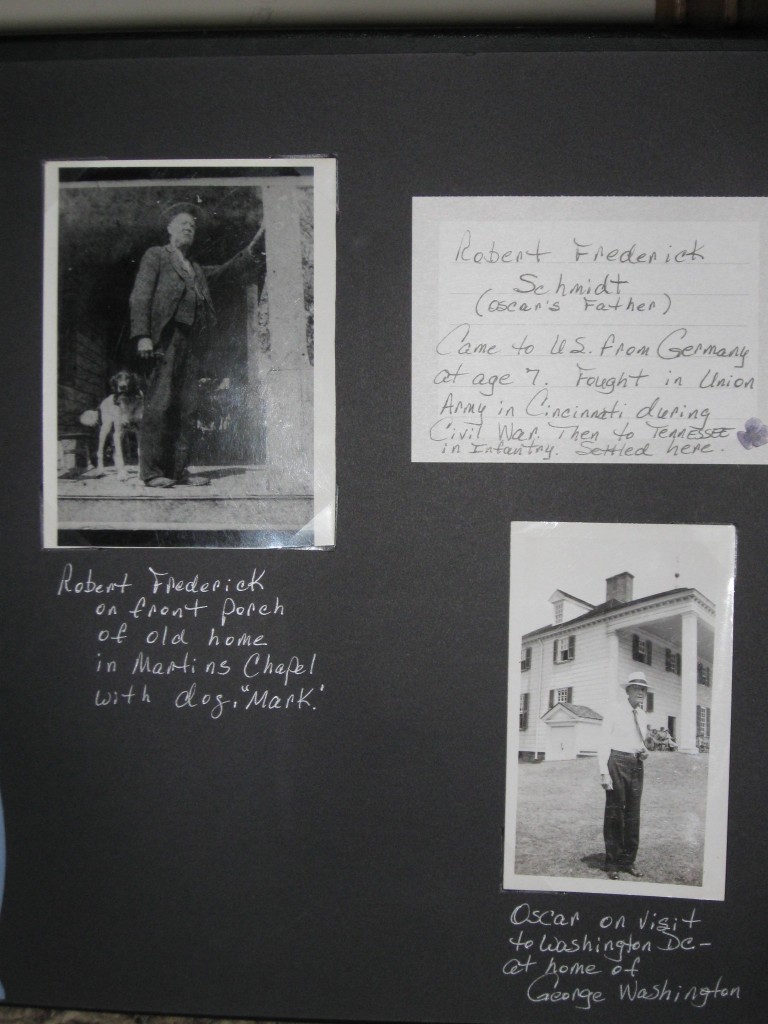
Robert Frederick Schmidt, my husband’s great grandfather.

- The Schmidt Family Migrates to Washington, D.C., in the 1930s, where the two brothers, Arno and Malcom, take over a block company to save the farm in Tennessee from back taxes their father owed. When one moved, the entire family went too. They returned to the old farm in the 1960s.

My father-in-law Arno was devilish in his youth. I should add even into his old age.
These layouts went into one of my black leather albums and then displayed at Mr. Arno’s funeral visitation. Sometime in the future, these photos and stories might not have been identified by younger generations, and while I didn’t write a lot, or print with my computer, the stories will live on.
Future Vintage
I’ve done my best to create recent layouts with photos and stories that will someday be as important as the old ones above.
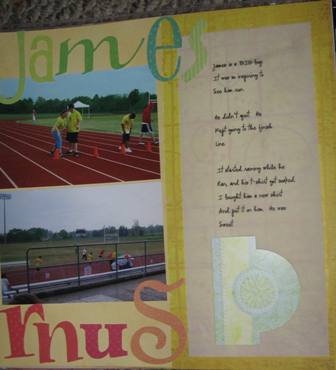
James Runs...in Special Olympics. A schoolmate of our son, a "big" boy, pushes on through rain and exhaustion to the finish line. I will always remember that day and the tears on my cheeks.

- My husband’s antique steam engine, used in the past at the Schmidt Sawmill on our land. It’s adorned with Christmas lights during the winter holiday season.
While I can be creative if I choose and take time with all of the products at my disposal, I don’t always do it. The creativity is more to feed my own crafty soul. It’s the photos and the stories that matter most.
Possibilities Abound
I never finished my degree in journalism because I switched to court reporting, but with my camera in my backpack and the words in my head, I can create many gifts for the people I love.
One doesn’t need to be a professional photographer or journalist to explore the opportunities. What’s important is a watchful eye in your day-to-day life and curiosity to uncover stories about old pictures.
I hope you put your creativity to work and let us know how this ScrapMoir has helped you in your scrapbooking or in writing your memoir. As always, we love comments.
Bettyann Schmidt
Be sure to join me on my blog:
Journey2f.blogspot.com
memoir writing
memoir
writing
scrapbooking