Post #60 – Women’s Memoirs, Book Raves – Kendra Bonnett and Matilda Butler
Sometimes a memoir is so beautifully written that you look forward to the next sentence and the one after that and the following one. Paradise, Piece by Piece is such a book. Molly Peacock tells us the story of why she chose to be childless in spite of the social pressure to have children, in spite of comments that she wouldn’t be a complete woman without children, in spite of self doubt about the possibility of growing up herself if she didn’t have children.
This is a memoir that will speak to everyone who has decided to not have children. But more importantly, it speaks to the rest of us who did have children. It causes us to hold up our decision to life’s mirror and try to understand the motivations behind our behaviors.
Molly Peacock is a memoirist writ large. She comes to memoir writing from her experience as profession as a poet. I’d like to share a few of her sentences with you. I hold these up as models even though few of us will reach her level. In her writing, I find the attention to word choice that is remarkable. Perhaps we should aspire to crafting a few such sentences. Her writing gives us a glimpse of beauty.
First, I’d like to share her entire first chapter:
“When I was three, I decided not to have children.” (p. 3)
That’s it. That is the entire chapter. I was hooked or at least nibbling at the hook. I turned the page to see what was coming next. She wrote as the first sentence of chapter two:
“I knew that goodness had a shape, and I could draw it: a circle. (p. 4)
I was hooked then. I’ll admit that I didn’t know exactly what she meant but the thought ran through my head, “Now this is going to be interesting.”
Let me share a few other treasures:
“Somehow at five, I was past childbearing age.” (p. 8 )
Molly is given a box and she describes it this way:
“I tore at it hard. It was taped up with so much Scotch tape it seemed bandaged.” (p. 47)
Suddenly that seemed like the perfect description for some boxes I’ve received. I’ll never see another severely taped box without thinking of her description. That’s the way that a writer haunts us in the months and even years after we read a delicious book.
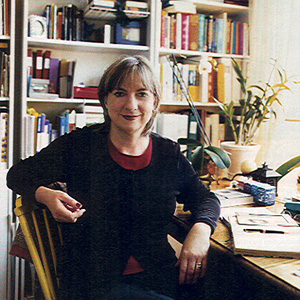
Molly Peacock, Photo by Marc Royce
“On the laws, sprinklers came on, and people called from their backyards. The smell of wienie roasts came up through the thinning heat, and to waste time I looked at the sky.” (p. 50)
Recounting conversations with her therapist, she provides a strong visual that I’m bound to remember.
“‘I’m in a mental wheelchair,’ I said to Ruta every Friday. ‘I look normal, but I’m not.’” (p. 220)
And how about this for a description:
“She was an unyielding as a new shoe.” (p. 230)
I’ve saved for last a special sentence, taken from early in the book. I hope you’ll read it several times to examine how she moves the reader through multiple states and reveals much about her parents within a single sentence.
The author is about five years old in this scene and doesn’t know how to write. Because she wants to send her grandmother a note, her mother writes the letters to several words for her. She struggles to replicate the right letters to form the words. She has just shown her note to her mother.
“The writing drew a smile from those straight, slightly purplish lips whose carmine lipstick had disappeared to find a better home on the filter tips of cigarette butts in a square glass ashtray, an ashtray so heavy that when my father let it fly against the wall in an argument it didn’t even break.” (p. 11)