Post #44 – Women’s Memoirs, ScrapMoir – Matilda Butler and Kendra Bonnett
Kendra and I are pleased to publish Lanie Tankard’s story and recipe that received an honorable mention in our March Memoir Contest–KitchenScraps Category. Congratulations Lanie.
This is the final story to be published from the March contest. On July 15, we will publish the first Honorable Mention Winner from our April Women’s Memoir Contest.
THE BEAN POT
By Lanie Tankard

…And pluck till time and times are done
The silver apples of the moon,
The golden apples of the sun.
—William Butler Yeats
The Song of Wandering Aengus
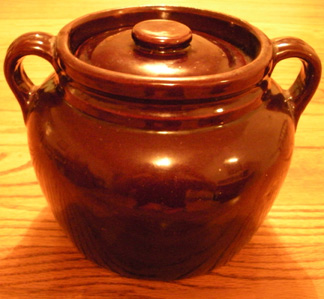
There it sits — squat, brown, and redolent — right next to my stove. And if I lift the cover of my mother’s old bean pot, I swear I can still smell those Ohio apples fresh out of the oven.
Their aroma would fill the entire house — nay, the entire block — wafting up Selwyn Road like a Pied Piper to lure me home from school.
The Cleveland area is well known for growing apples. Sometimes our family would head out to the orchards to pick them on the weekends, or my father would take us to a fruit stand. My mother didn’t drive a car in those days, but she sure knew what to do with the apples we procured. She’d head straight home, pull out that bean pot, and start peeling.
A clay bean pot is glazed both inside and out. Its lid creates a stone oven that makes its own juice. The vessel keeps food temperatures either hot or cold for long periods of time. It can cook a small roast, baked beans, scalloped potatoes, or soups with equal ease. No wonder so many bean pots were passed down from one generation to the next before the invention of the modern-day electric Crock Pot.
When my sister and I cleaned out our mother’s house in Alabama after she died, we found the two-handled urn in her kitchen. Mom had used it to store such items as matches, key chains, coins, pencils, and whatnot in her later years. The bean pot is now one of my most treasured possessions.
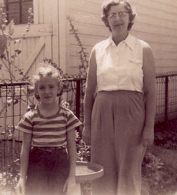
The Bean Pot Team
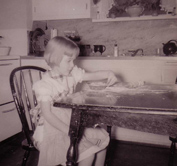
The Pie Baker
Mom would often bake some apples later in the week, too, if we’d bought a big bushel basket brimming full. Instead of quartering the apples before she cut out the seeds, as she did for the bean pot, she’d slice around the core in a circle almost to the bottom, pulling it out by the stem — POP! After packing the center hole with pecans, cinnamon, raisins, butter, and brown sugar, she’d set the whole unpeeled apples in perhaps an inch of boiling water in a pan. They’d bake in a moderate oven (350–375 degrees) for half an hour or so, until the scent would have us all lined up, spoons at the ready.
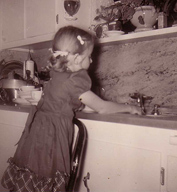
The Young Dishwasher
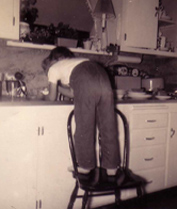
The Older Dishwasher
Mom always made sure I wore an apron when I cooked with her. She sewed a lot of aprons on her Singer electric, and enjoyed giving them to everyone she knew. I didn’t realize at the time how many she’d doled out over the years, but lately various folks have been passing them back to me as they winnow down their possessions.
“I thought your daughters might like to have these aprons their grandmother made,” said Cousin Judi when she sent me a package full of them.
“Remember when we pulled taffy?” asked my childhood friend, Angie, when she handed me a present wrapped in a red-checkered apron of my Mom’s last Christmas. “Your Mom buttered up our hands and let us make a mess. She was so much fun.”
She sure was. And as Alzheimer’s claimed more and more of her memories, I flailed around valiantly, trying to catch them on paper for posterity. Recently I ran across her recipe for Bean-Pot Apples. Holding the age-browned card in my hand, I looked long and hard at her handwriting.
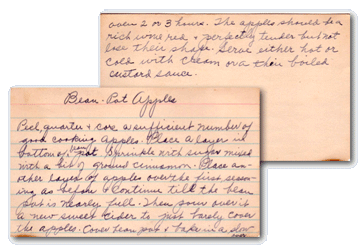
She usually wrote with a fountain pen filled with Sheaffer blue Skrip ink from a glass bottle, which had a small “tip well” at the top. Stains from an overturned bottle remain to this day in the drawer of her kitchen desk that is now mine. Last summer, when repainting that desk with one of her granddaughters, I pointed out the discolorations and reminisced. I treasure that ink-spotted piece of furniture far more than any new desk I could buy at OfficeMax. Those blue polka dots mark the passage of time and are evidence of a life lived.
As I held that recipe card, I glanced over at the old brown bean pot.
Hmmm, I mused, it would take only about ten minutes each way to walk to the store for apples this afternoon. How long might it take to peel them and pack that bean pot full? I could have my childhood on my tongue in just a few hours.
Toni Fuller’s Recipe for Bean-Pot Apples
Peel, quarter & core a sufficient number of good cooking apples. Place a layer in bottom of bean pot. Sprinkle with sugar mixed with a bit of ground cinnamon. Place another layer of apples over the first, seasoning as before & continue till the bean pot is nearly full. Then pour over it a new sweet cider to just barely cover the apples. Cover bean pot & bake in a slow oven 2 or 3 hours. The apples should be a rich wine red & perfectly tender but not lose their shape. Serve either hot or cold with cream or a thin boiled custard sauce.
Boiled Custard Sauce
Many easy recipes for a thin boiled custard sauce may be found on the Internet under Crème Anglaise or English Cream. Typically a real vanilla bean will be used, split lengthwise and cooked with the sauce. Afterward the vanilla seeds are scraped into the custard, creating black specks throughout. The trick is to cook it on low heat so that the egg yolks don’t end up scrambled. That common problem may be why Englishman Andrew Bird invented a powdered form in 1837, still sold as Bird’s Custard in many grocery stores.
Lanie Tankard is a freelance editor and writer in Austin, Texas. Her three daughters are proud apron wearers.
©2010 by Elaine F. Tankard. All Rights Reserved. May not be reproduced in any form without permission.
memoir writing
memoir vignette
memoir scrapbooking