Post #29 – Women’s Memoirs, ScrapMoir – Matilda Butler and Kendra Bonnett
By Bettyann Schmidt
We’ve talked a lot about saving our memories, using scrapbooking as an aid in the process, but an important element that goes along with writing our stories is the creative energy to help us get over the hurdles. I have some resources to help you.
A Likely Scenario
You’ve pulled out some photos and you have the makings of a story in mind. But you sit and ponder, unable to get started, and finally put the photos away and tell yourself this doesn’t work.
Well, first of all, I’m convinced that nothing worthwhile comes easy—at least not for me and lots of other people I’ve talked to. And, second, you are not alone in trying to chase down a muse to inspire you. My muse likes to go on vacation when I need him most. And, yes, it is a “him.” Any being so noncommittal must be a male.
So how do we find the creativity to pull our project together in the absence of that bad-boy muse? We need a little fuel for our creative flame.
Tracking Ideas
Writers: Quite a few resources are available for keeping track of ideas, and this is one of the most important ways to fuel your creativity. Not many people sit down to craft, be it a novel, a memoir, a piece of art, or a scrapbook, with an idea they already have in their head. The best way to do art of any kind is to have a surplus of ideas that you can tap at any moment when you feel like creating.
I have an “Idea Tracker” for my writing, which I’ve used for years. I keep it in my planner that goes everywhere with me. No matter where I am, even in my car, I can scribble (while keeping my eyes glued to the road) a word or two to remind me of the idea I just had. Granted, the penmanship is pathetic. That’s why I use a pencil with an eraser. Later, when I get to where I’m going, I can erase and rewrite legibly my idea. My tracker is in table format. I print out the sheets myself, hole punch them and put them in my planner. In column one is the title of my idea, column 2 the description, i.e., magazine article, book chapter, etc. And that’s all there is to it. Anyone can do it. That’s what I use for writing ideas, including this blog.
Scrapbookers: I also use my planner to scribble ideas when I’m out, but I transfer them to my homebound Idea Binder when I get the opportunity. In this three-ring binder I have a list of my page layout ideas plus ideas for theme scrapbooks and lists of photos I want to work with and maybe even color combinations. I sometimes glue small squares of cardstock or patterned paper on notebook sheets to “see” various color combinations. I have a divider section for sketches and page maps, which are free on the internet. These are layouts you can copy, or in scrapbooker’s lingo “lift.” One of the best sites for sketches is Becky Fleck’s PageMaps. Another divided section in my binder houses class notes and articles.
Journal. I use my journal to note ideas, if I’m writing in it at the time. An idea might just leap onto the page before I can stop it while I’m doing Morning Pages (The Artist’s Way, Julia Cameron). I just keep on writing and draw a star next to my idea. Then later I can transfer it into my binder, or my planner if it’s a writing idea. Use your journal for items you want to remember later.
A digital journal is also a good way to keep track of ideas. Here’s one I created using one of the Nature Journal kits from http://www.cottagearts.net

I can print the journal and put it in a small binder or notebook or just keep it on my laptop. You’ll notice I used a “list” in this entry. Journaling doesn’t have to be paragraphs of writing. A lot of my journal posts are in list form. I also use a lot of little stars and sometimes small stickers to denote important stuff.
Calendar: If you don’t journal, or are in a hurry, a way to keep track of your ideas is to note things, events, everyday activities in the blocks of a calendar. I created a digital calendar (template from www.cottagearts.net) to show you how I keep a record of happenings in my life.

The calendar will inspire you more than you think when you are ready to scrapbook or write. Of course, if you keep a calendar like this for many years, you can flip back and find memories galore. My planner calendars are a good source of inspiration, especially at the end of the year. I can go back through the months and see the events that took place. Write in your calendars the small, evereyday events as well as the big, important things.
Our Feral Cats Story
The digital calendar photo I used above reminds me of the three kittens of a feral mama we adopted soon after they were born. We have stories about the kittens and the mama, especially how Gary, my husband, finally was able to catch “Mama Kitty” so she could go to the vet and be neutered. It’s a cute story because he caught who he thought was Mama Kitty, and later the vet’s office called and said the cat he dropped off was a male! He looked identical to Mama, and I guess Gary didn’t look closely enough to the underneath parts. We had him neutered anyway since he was already there, and then we had to try again to get Mama, and finally we did.
Now the babies are ready for neutering. Doing what we can to help reduce the number of orphaned kitties in this area and documenting it along with all of our family memories. Years from now, perhaps the stray-animal problem won’t exist, and these stories will be even more interesting.
My Theory of Relativity
When you get to the point where you “think” like a scrapbooker or a family historian, you’ll begin seeing events in a different way. For instance, two weeks ago, I went to Cincinnati, my home town, to attend the funeral of my favorite aunt, Dot Mertz. Aunt Dot lived a good, long life and raised seven children. They were all there, and I hadn’t seen them in years. My Uncle Bill (her husband), age 87, was also there and still the funny and sweet man he has always been. We relived a ton of memories in two days. My cousins had put photos on boards along the wall and, misty-eyed, I looked at those old pictures of Aunt Dot as a beautiful teenaged girl who thought I was a baby doll to play with and spoiled me royally. I snapped a few shots from the display and also took pictures of my seven cousins and their father.
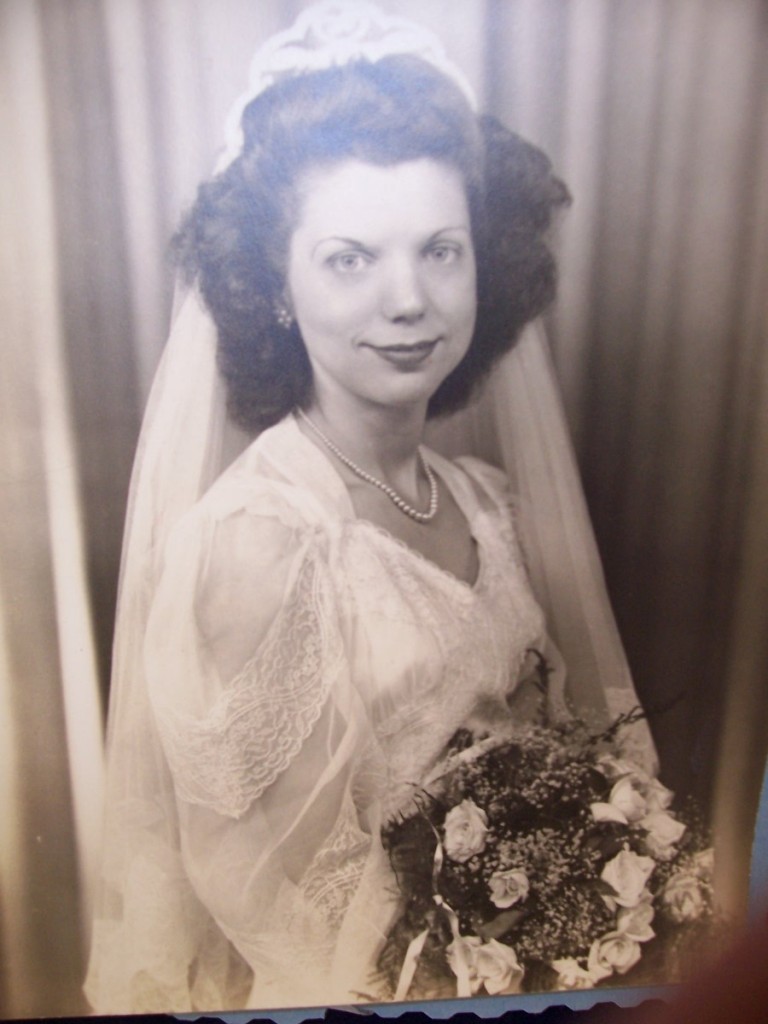
The five hours it took to drive home, I laid out a mental plan for a scrapbook layout to memorialize my aunt’s funeral and seeing all my cousins. I wanted to tie the old with the present and settled on a rather simple digital layout which went on my blog, so my cousins could see it.
A Spoiled Girl Story
I spent a good part of my life, when I was a baby and toddler, at my Grandma’s second-floor apartment, in an old, narrow red brick building just minutes from downtown Cincinnati. Grandma’s apartment was a fun place for me because my two aunts and one uncle were still living at home. Dad was the oldest and the first to marry.
My Uncle Bill still tells the story of the first time he came calling on my aunt. In fact, at 87, he was still telling this story to people at the recent funeral.
The story goes that when I realized that this strange man I’d never met was going to take my aunt away, I marched up to him and kicked him good in the “shins.” I must have been age three or four. For some reason everyone thought this was funny. I’m not sure Uncle Bill though so that night, but he does now.
When my aunt and uncle’s first child was born, Mary Lou, I began my career as a babysitter, which lasted throughout my teenage years. There was no house I’d rather be than Aunt Dot’s and Uncle Bill’s. It was a happy home, a lively place with all the children living there and a cat and dog. It was mentioned in my aunt’s eulogy that five daughters all shared one bedroom. As staunch Catholics, every Sunday my aunt and uncle herded the children (and me when I stayed there) into the station wagon and at the church led us all into a long pew. All seven children attended Catholic school through twelfth grade. My aunt fulfilled her mission in life, to raise a large family in the Catholic tradition of her ancestors. But, even more, she enjoyed doing it.
When the children were older and gone from home, Aunt Dot fulfilled another of her longings: She sang and entertained. For fifteen years, she belonged to the Sweet Adolines, and then she sang at a local club on weekends. Her favorite song to sing was “Crazy,” an old Patsy Cline hit. She also played the harmonica to entertain folks.
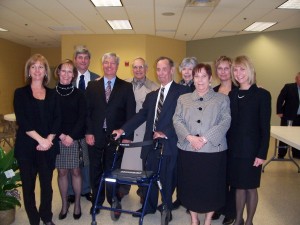
The Mertz Family, March 3rd 2010
You can visit my blog to see the layout that combines the two photos from my aunt’s funeral. Present day events, combined with old memories and/or photos make good stories, create good “connections.” If you have a family gathering, a wedding or funeral or any big event, try to find some old photos of the people attending and draw the two together to spark your creativity.
Classes, Books, Articles
I mentioned above that I keep clipped articles from the net and magazines in my Idea Binder, which stays on a shelf behind my work table. When looking for inspiration, I go to my binder first. In addition, you’ll find many online classes on the web that can provide the fuel you need, and many of them are free or inexpensive. Our own Women’s Memoirs here offers outstanding memoir classes, and Story Circle Network is another excellent source for learning.
Currently I’m taking the “Library of Memories” class from Stacy Julian at Big Picture Scrapbooking, which also has lots of other classes, many free or for a nominal fee. All of them will inspire you.
Another class I recommend is Blogging for Scrapbookers. One doesn’t have to put their blog on the net for others to see; it can be a private holding area for your layouts, photos, thoughts, ideas. Several blog sites are free, Blogger for one, which I use. This class is self-paced, so it’s always open in the forum.
Debbie Hodge has quite a few classes for scrappers and crafters, and several are free, like Scrap YOUR Story, and you can join even though it’s into the third week. It is also self-paced. The emphasis on “YOUR” here means this is a class focused on YOUR life. The first class was YOU in the present, your truths about yourself. Then the second was Your Origins, your family, the home you lived in, city, etc. We’re on week three, Your Childhood, but I’ve just completed Week One. This class is wonderful for memoirists and anyone interested in completing an album about herself. Go to my blog to see more info on this class and the layout I created for “Me, Present Tense.”
Debbie Hodge also has anotherer free class on her site that I like, “The Street Where You Live.” This is a good class to help get the hang of taking photos on a specific subject and then creating layouts with your writing.
Interviews & Listening
If you have family members still alive, this is a must-do. Get their stories and memories down on paper. Use a tape recorder and then transcribe to paper. Better yet, shoot a video of them. Prepare a list of questions in advance, but if they get to talking on a certain subject, let them go. You just can’t tell where their memory will take them. Also try to use open-ended questions, like “How did you spend your days in the summer when you were a child?” Some of the best stories will come after they have been talking a while and are loosened up.
This is what happened with my father-in-law before he died. My mother-in-law said, “Oh, he’s making some of that up. He doesn’t remember right.” I said I didn’t care; just let him talk because it was so good. He said he met General Dwight D. Eisenhower when he was in the army. Mother-in-law said, “He didn’t meet Dwight Eisenhower. He’s making that up.” I will never know who was right, but I loved listening to that man tell stories. As far as I’m concerned, he was truthful. If he wasn’t, it was only because he was so old, a few years before his death at age 96. My father-in-law was one of the most honest men I’ve met, so he wouldn’t have been lying on purpose. It was his story the way he remembered it.
Go Surfing
… on the web that is. I love searching events that occurred during certain time periods. This is good research for your memoirs and scrapbooks. My father was born in 1920, so searching worldwide events taking place that year gives me plenty of ideas for memoir, especially events taking place in Cincinnati. For instance, I came up with the list of Cincinnati Reds players and the 1920 season highlights on my first search, a huge goldmine for story, because my Dad loved baseball and often took me to the old Crosley Field for the games. I remember the hotdogs and Coca-Colas, and the peanuts. I may have not remembered this very important memory were it not for the internet.
You’ll find, as you use the resources I’ve mentioned, that your creative self will begin to find more and more ignitable fuel. It’s a process. The more you search, the more you find. The more you find, the more ideas you get to research. And on and on.
I do hope you are gaining a feel for combining scrapbooking and your photos with writing memoir. I can’t think of anything as gratifying besides having people who love you. I never thought I would enjoy researching my family and telling their stories or crafting memory albums. Now, I can’t imagine not doing it. Memories and stories are what make the world go ‘round.
It’s History. I always like to think that every day I’m alive is a day of history in the making, and I am eager to document every moment of it if possible. The little things that happen throughout our everyday lives may someday be important to our grandchildren’s grandchildren. What would you give for an album or scrapbook of your grandparents’ grandparents’ daily lives, struggles, joys, thoughts, insights, deep feelings?
I welcome your comments, as always. Go to my blog to read more of my “Journey.”
Bettyann Schmidt
http://journey2f.blogspot.com
memoir writing
memoir vignette
memoir scrapbooking
memoir scrapbooking how to