Post #27 – Women’s Memoirs, Writing Prompt – Kendra Bonnett and Matilda Butler
Some of my earliest memories are about cooking and food; it’s my mother’s gift to me. We made noodles by hand when I was very young. Moo (our nickname for Mother) rolled out the dough and sliced her noodles one at a time. My job was to unroll each noodle and lay it out to dry.
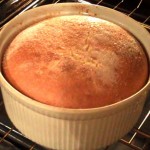
On Christmas, I cooked my very first souffle (vanilla), thanks to Matilda and my new Julia Child cookbook.
We bought our first hand-crank noodle maker when I was six. We found it in a little shop in New York City. We admired the beautiful chromed-steel Atlas Noodle Maker for a long time, then huddled like conspirators to weigh the cost versus the work of making our noodles by hand. In the end, we parted with the $25. That was a lot of money for a cooking gadget in the 50s. We used it together for years. Moo cranked; I caught.
Moo became interested in Asian cuisine in the late 50s. Mr. Collins, an elegant Caribbean gentleman who spoke with a British accent (think of the actor who used to do 7-Up commercials wearing a white suit) arranged for Chinese cook Florence Lin to come out once a week and teach at his gourmet market, the Caribbean Room, in Darien, Connecticut. Moo took every class Mrs. Lin offered. In fact, Mrs. Lin once said that she had to keep expanding her repertoire and recipe offerings just so she’d have something new for my mother. This was long before Mrs. Lin began writing cookbooks and teaching at the Asian Culinary Arts Institutes in New York.
I tell you all of this as an explanation of sorts. While most home cooks were discovering Julie Child and French cooking, my mother was expanding her knowledge of Asian food. For that reason, I knew more about lion’s head pork meatballs, miso soup and Thai curry than about potage, soufflé or quiche. Don’t misunderstand. I love cooking and eating Asian food…any and all…but I always wanted to know more about the theory and basics behind western cooking. And for that, one must read the bible—Mastering the Art of French Cooking
by Julia Child, Simone Beck and Louisette Bertholle.

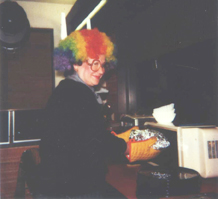
Considering she practically lived in the kitchen, it's odd that this is the only photo I have of Moo cooking. It was a Super Bowl party, hence the wig.
When my mother died in 2001, she left a library of about 500 cookbooks. She had a copy of Irma Rombauer’s Joy of Cooking
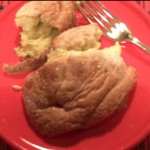
My souffle tasted as good as it looks.
Watching Julie & Julia
Women’s Memoirs KitchenScraps
The idea for ScrapMoir and KitchenScraps came out of a conversation Matilda and I had one afternoon. Although Matilda and I live on opposite coasts, we both have Verizon cell service. So we talk long and often. I forget all the details that led to ScrapMoir (maybe Matilda can remember and add a comment) but we wanted something that captured more than a memory in words. We wanted something visual. Recognizing the popularity of scrapbooking, we thought there was a kernel of an idea in incorporating aspects of the craft phenom with writing. Then we got the idea to build a series around treasured family recipes…and well, KitchenScraps was born.
We publish a new KitchenScrap each Thursday, and there’s a story behind that too. Both Matilda’s and my mother regularly read their local newspapers on Thursday because that was the day of the week when cooking columns and recipes were traditionally published. So in deference to our mothers, KitchenScraps also runs on Thursday.
If you are interested in writing a KitchenScrap about your memories of food, family and cooking and have a wonderful recipe to share, please let us know. We’d love to add you to our KitchenScraps family of authors.
Writing Prompt
We’re so interested in attracting new authors for KitchenScraps that Matilda and I decided to dedicate today’s writing prompt to KitchenScraps. Give it a try.
1. What did food mean in your household? Did your father have a barbecue ritual? Did your mother cook up holiday gifts for friends and neighbors? Was your mother or grandmother known for a special recipe? Tell the story. Tell us about the characters, the smells in the kitchen, the family traditions that you have continued. Share your story in 250 – 500 words and include photos and a recipe.
2. Maybe cooking wasn’t important to your mother or grandmother. Maybe your father was the primary cook. Or maybe you ate out or ordered take-out. Perhaps you felt something was missing and went on to become an accomplished cook. That too is a KitchenScrap. Tell us how you came to cooking and give us one of your recipes. Don’t forget the photos.
3. And finally, maybe you have one special story…a holiday that went wrong, a disaster in the kitchen, an event celebrated in food. Try your hand at telling that story in 250-500 words. What did it mean to you? It’s not just about the food; it’s your story. Tell it in words, photos and recipe.
My Recipe Gift to You
I’ve told you that we didn’t eat much French food. As my mother would say, that’s the cook’s prerogative. For the most part, we ate what she liked to cook. There was one exception to all this. We spent our spring vacations in Arizona. That too was unusual; Easterners all went to Florida or the Bahamas in the 60s. But we were different; we went to Scottsdale, which still had a small-town authentic western feel in the 60s. It hadn’t been “discovered” yet.
But there was one terrific French restaurant—Etienne’s. It turned out that Chef Etienne had moved to Scottsdale from Cleveland and started his own restaurant. Through friends, my parents had met Etienne in Cleveland and appreciated his food…even though it was French. Etienne was a delightful man—charming is the word that comes to mind. I remember that he always kissed your hand upon greeting or saying goodbye. Even my sister and I got our hands kissed…I think it’s the only time in my life.
Etienne cooked a delicious Medallions of Beef Tenderloin. He most graciously shared the recipe with my mother, and I’d like to share it with you. It’s simple and very special. I rely on this recipe whenever I want to impress. Paired with an exceptional green salad, which I spike with fresh herbs (e.g., cilantro, fennel, spearmint, tarragon, lamb’s tongue) and finish with a curry dressing. Okay, now I’m hungry.
Etienne’s Medallions of Beef
If you want to start with a whole beef tenderloin, you can cut the medallions (filet mignon steaks) to the thickness of your choice. I usually buy filets from the butcher, but recently I’ve been eating buffalo meat and have found an acceptable buffalo filet in my supermarket. They come two to the package.
Prepare filets by drying the meat (as Julia fans, we all now know this helps the meat to brown). Heat a little olive oil in a large skillet over medium heat. Sprinkle steaks with cracked pepper and onion powder (no salt). Pour about a jigger of bourbon into a metal measuring cup. My mother used Four Roses; I used to use Jack Daniels but now prefer the taste of Maker’s Mark.
Sauté steaks about 4 minutes per side for medium-rare (slightly less for rare and longer for well-done). Transfer the steaks to a plate and turn the heat down to low. Also warm the bourbon just slightly by putting the metal measuring cup on a warm (Simmer) burner. To the skillet, add about 1 T of mustard per steak and mix in with the oil you used to cook the filets. Here too I’ve updated the recipe. My mother always used French’s Mustard; I prefer Grey Poupon but there’s a lot of room for you to experiment with different mustards.
Lightly salt the filets and return them to the skillet to warm and coat with the mustard mixture. Cook about a minute. Carefully add bourbon to the skillet and light with a match. If you’ve never flamed anything before, you’ll want to do this very carefully. If you have a vent fan running, you might want to turn it off. Be prepared for the “whoosh” when the alcohol first catches fire. The flame quickly subsides, but to be sure that you burn off all the alcohol gently rock the skillet by tipping it forward and backward a few times. Soon the flame will go out.
Remove the skillet from the burner. Plate the filets and drizzle a little of the mustard-bourbon mixture over each of the filets. Serve immediately.
Our Amazon Links
In some blog posts we add links to products. We are an Amazon affiliate, and while your price remains the same whether you order through us or not, we do earn a small percentage of the sale when you click on any of the links on our website. So if you are thinking of buying any of these products and do not object to Women’s Memoirs making a small bit off your purchases, we’d be pleased to have you use our links.