Post #107 – Memoir Writing – Kendra Bonnett and Matilda Butler
Women’s Memoirs is pleased to welcome Susan Wittig Albert, NYT bestselling author and founder of Story Circle Network. Susan’s most recent book, A Wilder Rose
[We invite you to leave Susan a comment or to ask her any question you might have about the use of a family diary. Then return on Thursday as Susan suggests ways you might use your own diary or journal or even one you have discovered that belonged to a relative.]
Women’s Diaries: A Record of the Present, a Legacy for the Future — Part One
We are never aware of the present; each instant of living becomes perceptible only when it is past, so that in a sense we do not live at all, but only remember living. And we are blind to conditions forming our lives, until those conditions are becoming part of the past.–Rose Wilder Lane, Old Home Town
 As a memoirist, I know the importance of keeping a journal, of paying attention to the events of my life and recording them, so that I can understand myself: what I do, why I did it, and what have been the outcomes. As a novelist who often writes about the lives of real people, I am delighted when I discover that one of my subjects has kept even the barest of records of her (or his) life. A diary anchors me in the realities of my characters’ lives and allows me to eavesdrop on their doings and feelings. It permits me to enter their interior lives.
That’s why I was delighted to discover that Rose Wilder Lane (1886-1968), a woman I was considering as a possible subject of a book, had faithfully kept a diary during the years of her life that most interested me. Rose was an important journalist, travel writer, novelist, biographer, and magazine fiction writer. Two of her novels, Let the Hurricane Roar (1933) and Free Land (1938) were bestsellers as magazine serials and as books, and her treatise, The Discovery of Freedom (1943) has become a political landmark. She was also the only child of Laura Ingalls Wilder, of Little House fame (Little House in the Big Woods, Little House on the Prairie, etc.), and she lived on her parents’ farm during the years when the first three books in this series were written. When I found Rose’s diaries and discovered what an extensive record she had kept of her daily activities (writing, reading, thinking, traveling, doing chores), I decided to use it as the foundation for a fact-based novel, A WILDER ROSE
The Diary of Rose Wilder Lane
Since the 1980s, literary scholars have suspected that Rose played a substantial role in preparing her mother’s books for publication, but others felt that the arguments didn’t have a very strong foundation. Rose’s diary, however, provides that foundation—and to my mind, settles the argument, once and for all. In general terms, it tells us how the series came to be written. Specifically, it tells us just how much “book doctoring” time Rose poured into her mother’s books. It also tells us what else she was writing and what other things she was reading, doing, and thinking about. It illuminates the mind of a woman who lived a remarkable life.
During the years Rose spent on her parents’ Missouri farm (1928-1935), she recorded the facts of her life in two Line-a-Day diaries, small books about 4”x 5.5” with ruled pages and space for five entries on each page. The diaries, with Rose’s letters and other papers, are held in the Herbert Hoover Presidential Library. (In 1920, Rose wrote a biography of the soon-to-be president; over the years, they developed a friendly relationship, and after her death, her literary executor deposited her papers at the Hoover Library.)
On one of my several visits to the Herbert Hoover Library, I photocopied both diaries. Later, back home, I transcribed them to a computer file. Since there are nearly 73,000 words in these two diaries (about 2400 entries), that process took over 200 hours and occupied many evenings during the summer and fall of 2010.
But it was important for me to do this. As I transcribed, I read much more carefully than I would have if I were simply scanning for information. And the transcription made it possible for me to study the text closely and annotate it, with reference to Rose’s letters and other documents available at the Hoover Library and elsewhere. Also (and this is important) the file is searchable. I can easily look for specific items, which makes it possible to study the text in detail.
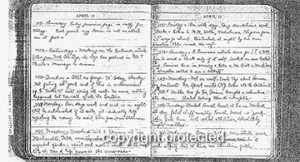
As you can see from the photocopy, Rose’s handwriting is clear and easy to read. Her entries are mostly factual notes about what she did, with occasional notes about how she felt. (She recorded deeper feelings in an intermittent journal.) On April 17, 1931, for instance, we read that Rose dug dandelions out of the lawn at Rocky Ridge Farm, where she was living with her friend, Helen Boylston, (later the author of the Sue Barton, Nurse and the Carol Page, Actress books for girls). On that same day, she wrote letters to two author friends, Mary Margaret McBride and David Malcolmson, and to Mary Margaret’s housemate, Stella Karn. A telegram from Lowell Thomas (a journalist who had commissioned her to ghostwrite a book that would be published as This Side of Hell, under the name of Dan Edwards) told her to go ahead with the Edwards project, for which she would earn $1,000. That night, she was awakened by prowlers, but Peter (a recently-adopted dog) apparently frightened them off. I am amused to read that Rose considers this an “idle” day—but I know from other entries that by “idle,” she means that she didn’t get any serious writing done.
On the same day in 1933, two years later, she isn’t feeling well. But she manages to write to George Bye, the agent who represented both her and her mother, about the Farmer Boy contract. (I have a copy of her letter to Bye: reading it, I see that she is objecting to the low royalty rate in the contract, asking Bye to see if he can get it raised—a good example of the way she managed her mother’s publications.) She also received a letter from Mr. Spock (Bye’s secretary), saying that Ladies’ Home Journal had agreed to pay $750 for her short story, “It’s the Sentiment,” which would be published in the December issue that year. That afternoon, her mother came for tea (and probably a chat about the Farmer Boy contract and Rose’s letter to Bye). In the evening, her friend Corinne Murray (travel companion and later housekeeper/cook) brought her a potted columbine. Apparently concerned that she might be anemic, Rose began taking Bland’s Iron Pills, which was widely advertised at the time as a “blood enricher.” Drugstores sold a bottle of 100 pills for fifty cents.
As you can see, Rose’s diary is a goldmine of descriptive material, allowing us to see what she did almost every day and how she felt about it. Money, for instance, is a recurrent theme throughout these years. On Oct. 28, 1928 (a year before the Crash, when Rose had plenty of money), she spent over $1400 on furnishings for the Rock House, her parents’ “retirement cottage,” which cost Rose the princely sum of $11,000. She writes that she lay awake most of that night, regretting the “banality” of the purchases and the size of the dining table (now in the dining room at Rocky Ridge) which she was convinced was too large. Two years after the Crash, on Feb. 29, 1932, she couldn’t work. “I am really sick with fear,” she writes. “I have not enough to pay tomorrow’s bills & no more in sight.” The Depression took a big bite out of everyone’s lives in those years. The magazines were buying fewer stories and Rose felt the loss of income keenly, since she was supporting both her own household and her parents’. (The Wilders had no cash income in those pre-Social-Security years, other than money they received from selling Almanzo’s milk and Laura’s eggs—and from Rose.)
These are just a few examples that went into my description of Rose’s life during the years of the Depression, but perhaps they will give you a sense of the importance of a diary in reconstructing a woman’s life. In Part Two of this post, I will focus on how you might use a diary that you possess—your own or someone else’s—as a primary source for your own writing.
Susan Wittig Albert is the author of A WILDER ROSE
With the holiday season approaching, A Wilder Rose just might be the perfect gift. It is available both in print and for ebook readers.
“Nuanced, moving and resonant… an absolute pleasure.” Kirkus Reviews