Post #68 – Women’s Memoirs, Writing Prompt – Kendra Bonnett and Matilda Butler
Memoir Journaling and Writing Prompt
Normally, thoughts about lemons and moving might lead to something like, “Do you think we can make lemonade out of this place?” And some of the homes we’ve looked at in the past few days definitely could be described as lemons. Since these are homes currently on the market, I won’t be specific. But I’m sure you know what I mean – homes with a great design but poor craftsmanship – homes that haven’t been updated since the 1950s — homes that are so cluttered you can’t see the bones. I’m a creative person and can usually figure a way that the home might be made to work. But today I want to take this blog in a different direction.
However, let me insert, for the benefit of those of you who have been following my journey from California to Oregon, the conclusion to my Day 10 journal entry about putting an offer in on a home. Yes, that was “a” light at the end of the tunnel but not “the” light. Our offer was met with a counter-offer that was too high for us to consider. Therefore, we’ve been out looking again and tomorrow will decide between two others that we are considering. I’ll let you know when the trucks finally get out of our way so that we can have a clear sightline to the end of the tunnel.
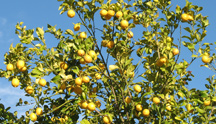 Today, when I say lemons, I’m talking about those lovely yellow fruits that add sourness and zest to everything from tea to carrot confit to lemon bars. I’ve even made preserved lemons from these gems. [See a few of my recipes below.]
How long has it been since you purchased a lemon? A day? A week? For me, it has been 38 years. Yes, that’s not a typo. At my home in Palo Alto, I had five lemon trees. When we bought that house in 1974, there was one Meyer lemon tree next to the front door. Over the 25 years we lived there, I added more trees including a Ponderosa lemon. I remember that one because it produced huge fruit. I always had plenty of lemons to use and could even pick one during a party if I had to make up more guacamole.
When we moved to Gilroy thirteen years ago, there were three Meyer lemon trees on the deck in large redwood pots. Shortly after getting settled, we began to purchase and plant more citrus, mainly lemons and primarily Meyer lemons.
Eventually I had about two dozen Meyer lemon trees, producing fruit all year long. No running to the grocery store for a lemon. I could Just walk out on the deck or walk under the grape arbor to the large stand of lemon trees or walk to the pond where two trees produced incredibly large, round fruit. I even had one pink lemon tree with beautiful variegated leaves. Why so many trees? They are lovely to look at and the bright yellow fruit makes even a rainy day look sunny.
With that many trees, I always had lemons, more lemons than I could use. This meant it was fun to share with neighbors and to send boxes of lemons as Christmas presents to family and friends all across the US.
Now, 38 years later, I wanted a lemon to dress the fresh broccoli I bought at Market of Choice in my new hometown of Corvallis. I couldn’t just go outside and pick one. So I did what almost every other person does. I went to the grocery store. I ended up getting a lime because they were just $.25 each while the lemons were $.45. Whatever happened to the nickel lemon that I used to buy 38 years ago? Well, I suppose inflation has affected the price of lemons just as it does every other product.
Memoir Writing Prompt
Turning lemons into lemonade is a generic trick that women are particularly good at doing.
1. Think of a time in your life when the situation was like a lemon. What did you do to turn it into lemonade? Did it involve a career situation? Was it a personal relationship that went sour? Write for five minutes.
2. Evaluate what you did. Were you happy with the outcome? Dig deep and write for five more minutes, exploring the details of the “lemon” and the “lemonade” outcome.
…………………
If you enjoy cooking, then you’ll like the many creative ways you can use this always-ready ingredient — lemons. Want something new and unusual to do with Meyer lemons? Try these crisps. You might tuck them on the edge of a stir fry or on top of the Pasta with Walnuts and Preserved Lemons (see recipe below) for a double lemon whammy.
Lemon Crisps
In a medium sized saucepan, over medium heat, heat 1 to 2 inches of the oil to about 250 degrees. After removing the ends of the lemon, use a sharp knife to create thin slices. Cut as thinly as possible. Dip each lemon slice in rice flour (easily available with other gluten-free flours) and fry in the hot oil until it begins to slightly brown. Remove from the oil and place on a paper towel to drain.
Lemon Salad
1/2 Meyer lemon per person
6 grape tomatoes per person
1/2 green onion per person
¼ c thinly sliced celery per person
1/2 T olive oil per person
Wash Meyer lemon. Cut off each end. Make ¼ inch slices and remove seeds. Cut each circle into 4ths or 8ths or a mixture of the two. Place in bowl.
Add:
Halved or quartered grape tomatoes, green onions sliced on the diagonal, and sliced celery.
Toss with olive oil. Add salt and pepper to taste. If you like a bit more bite, add a shake or two of cayenne powder.
Preserved Lemons
Preserving lemons, a Mediterranean technique, creates a delicacy that may become a regular feature of your cuisine.
These preserved lemons are really salty. Of course, that’s part of the pleasure of them. They are a wonderful addition to green beans, wilted kale, and other dark greens as well as Lemon Walnut Pasta. You can use the lemon juice brine as well as the lemons. Just a spoonful will season your greens, adding both saltiness and sourness. The finely chopped lemon (rind and inner pulp) contributes color and pungency to each bite.
4-5 lemons
2/3- 1 cup coarse sea salt
1½ c lemon juice
2 T olive oil
Wash and dry the lemons. Cut them into quarters without detaching the pieces completely at the stem end. In a bowl, toss the lemons with the salt, pressing down slightly on the lemons — just enough to extract some of the juice.
Place the salt-coated lemons in a 1½ quart jar. Fill the jar with enough lemon juice to cover the lemons completely. You may need to add a little more lemon juice and salt to fill the jar. Cover and keep in a cool, dry place for 2 weeks, turning and shaking the jar every day.
To store, top with a little olive oil and keep in the refrigerator. To use, cut off as many quarters as you want to use and chop. Preserved lemons will keep up to 6 months.
Note about Meyer lemons. In 1908, Frank Meyer, a plant explorer for the US Department of Agriculture, found this lemon tree, probably a cross between a lemon and a Mandarin orange, in China where it was grown as a courtyard tree. It is rarely available commercially because its thin, soft, smooth rind does not ship well.
Pasta with Walnuts and Preserved Lemons
Preserved Meyer Lemons are described above. Of course, the next challenge is to figure out how to use them. This recipe evolved over time and may become a family favorite with you. It makes a lovely party dish as well, especially with the fried sage leaves. These are not necessary but help make this an elegant entrée. Culinary sage can easily be grown in a pot just outside the kitchen door so you can just step outside and pick a few leaves. They are widely available in grocery stores.
Prepare pasta according to package. A fuscilli or penne works best. You can use a light wheat, whole wheat or even Trader Joe’s Brown Rice fuscilli, if you prefer a gluten-free meal.
While pasta is cooking:
Heat 1/3 to ½ cup olive oil in a skillet. Add chopped onion (1/2 onion) to olive oil. Add 1 cup chopped walnuts to onion and olive oil mixture. Cook for about 5 minutes. If mixture becomes fairly dry, add more olive oil so that at the end there will be enough to coat pasta. Minced garlic can be added in the final 1 minute, if desired.
Chop finely ½-1 preserved lemon. (See separate recipe above).
Drain pasta. Add olive oil/walnut mixture. Add preserved lemon. Stir to coat pasta.
Optional Topping: Fried Sage Leaves
Heat a small amount of olive oil in skillet. (Can use same skillet where you previously cooked the walnuts and onions.) When olive oil is hot, add 2-3 sage leaves per person. Fry on one side and then turn over and fry on second side. This will take about 1 minute. You’ll know when they are ready because they become crisp. Drain on paper. Place fried sage leaves on pasta once it is served on individual plates.
Options:
Portabella Mushrooms: Slice and pan fry in olive oil and place on top of pasta.
Add black sesame seeds
Asparagus: Grill and add to top of pasta